Health & Imaging
EMG Test for Lower Back Pain: What It Costs and What to Expect
Your doctor mentioned an emg test and now you’re stuck googling what that even means. Maybe your lower back pain has been dragging on for weeks. Maybe there numbness running down one leg that just won’t quit. Either way you want two things: a straight answer on what the test involves and a real number on what it costs.
Here’s the thing. EMG testing isn’t as scary as it sounds, and the emg test cost isn’t a mystery either once you know what goes into it. This article walks through both.
This article is for general information only and is not a substitute for medical advice. Talk to your healthcare provider about whether emg testing is right for you.
Need to Schedule a Diagnostic Appointment?
Whether you need an MRI, ultrasound, X-ray, or another diagnostic service, Advantage MRI is here to help you take the next step in your healthcare journey.
Submit your appointment request online, and our team will contact you to confirm your visit.
Book Your Appointment →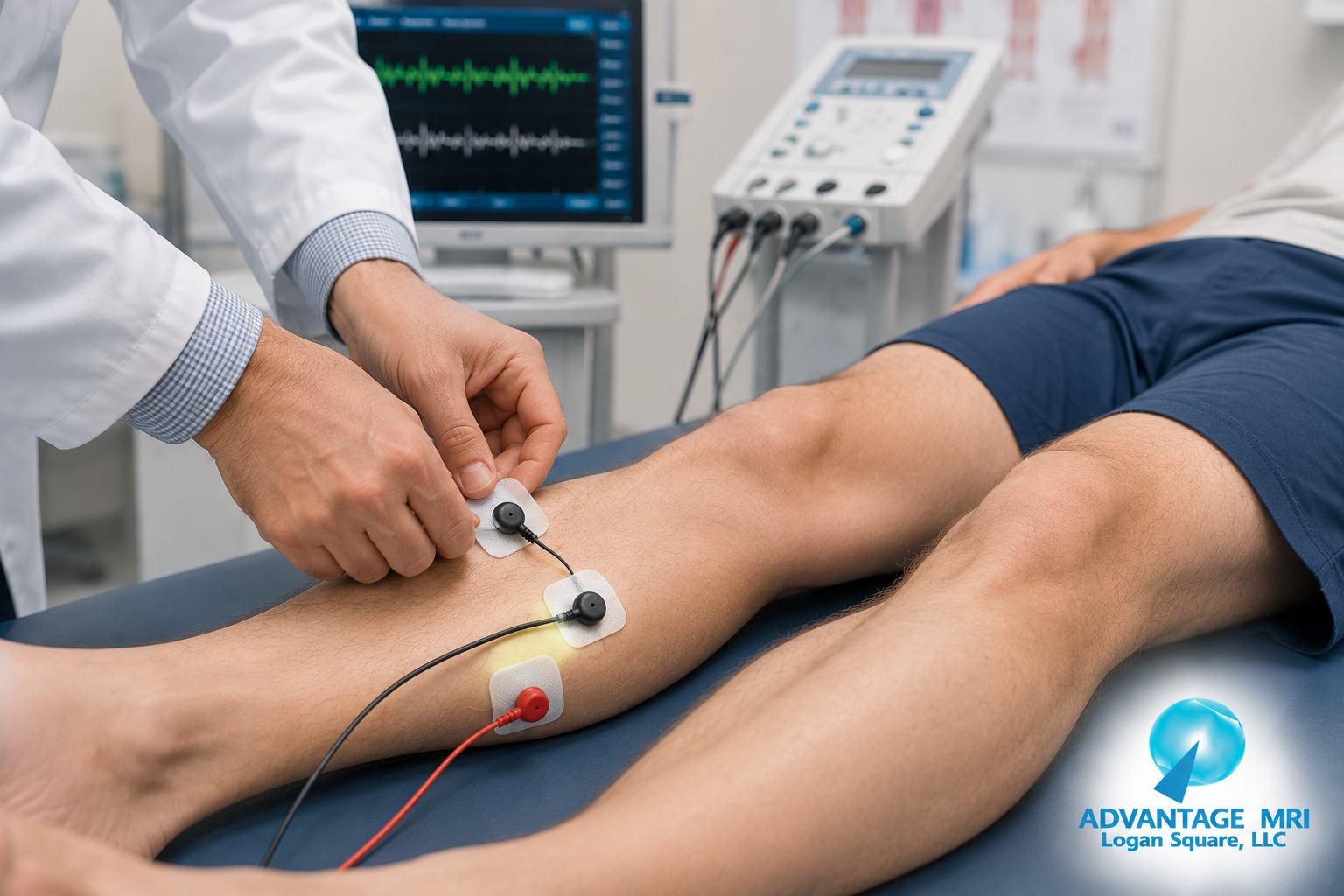
What Is an EMG Test and Why Your Back Doctor Ordered One
An emg test, short for electromyography, measures the electrical activity in your muscles. A small needle electrode gets inserted into the muscle and it picks up the electrical signal your muscle produces when it contracts and when it at rest. That signal tells a specialist whether the muscle itself is working right or whether the problem is coming from the nerve that controls it.
For lower back pain specifically doctors often order this test when pain in the spine is spreading into a leg. That pattern usually points to a nerve getting pinched or irritated somewhere along the spinal cord and an emg test helps pinpoint exactly where. It a way to confirm a diagnosis rather than just guess based on symptoms alone.
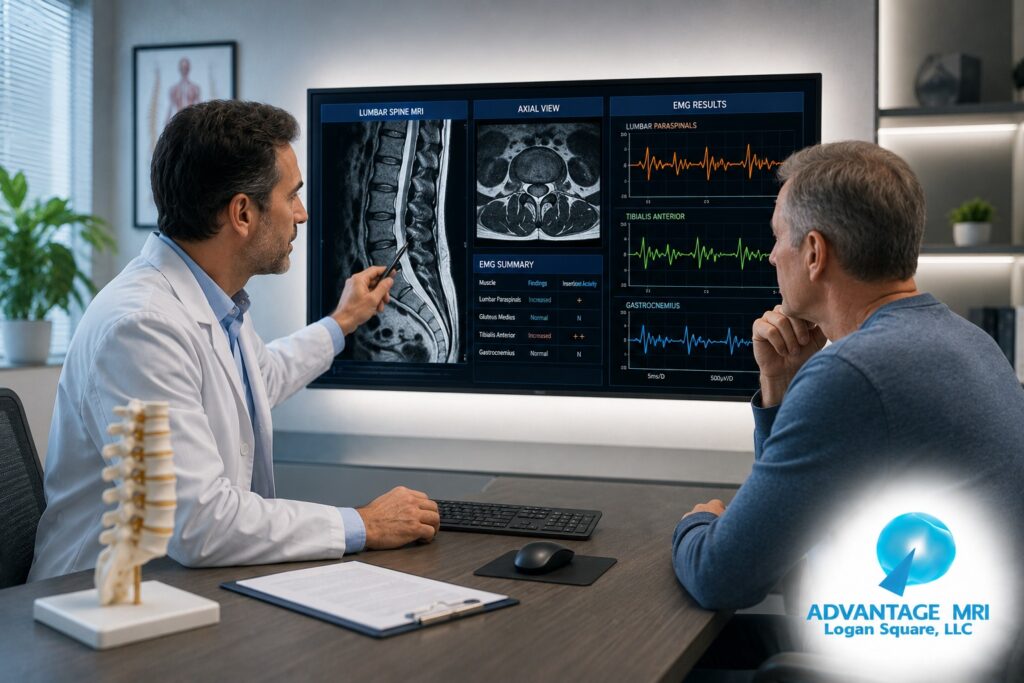
So why not just get an MRI? Good question and one a lot of patients ask. An MRI shows the physical structure of your spine, the discs, the bones, whether something is pressing on a nerve. An emg test shows how that nerve is actually functioning right now. In a lot of cases doctors want both, because one shows the picture and the other shows the performance.
| Test | What It Measures | How Long It Takes | Invasive? |
|---|---|---|---|
| EMG | Electrical activity in muscles at rest and during contraction | 30 minutes to an hour | Yes, needle electrode inserted into muscle |
| MRI | Physical structure of the spine, discs, bones, and nerve compression | 30 to 60 minutes | No |
| Nerve Conduction Study | Speed and strength of electrical signals traveling along a nerve | 15 to 30 minutes, often combined with EMG | No, surface electrodes with mild electrical stimulation |
Learn more about our MRI Imaging services if your doctor has ordered both tests together.
EMG Test Cost Breakdown
Let talk numbers because that usually the part people actually came here for.
Emg test costs vary quite a bit depending on where you live, whether you have insurance and how much testing your doctor actually orders. The price of an emg test on its own tends to run differently than when it combined with a nerve conduction study, which happens a lot since the two are often done together for a lower back workup.
A few things push the emg testing cost up or down:
- How many limbs get tested. A single leg costs less than testing multiple limbs.
- Test complexity. If your doctor needs a broader look because symptoms are unclear, that adds to the total.
- Whether you’re paying cash price or going through insurance with a deductible or copay.
- The provider and facility you choose, since pricing isn’t standardized nationwide.
The emg ncv test cost, meaning emg and nerve conduction study combined, usually costs more than either test alone simply because you’re getting two separate pieces of diagnostic information in one visit. That said a lot of patients find the combined price actually makes more financial sense than paying for two separate appointments.
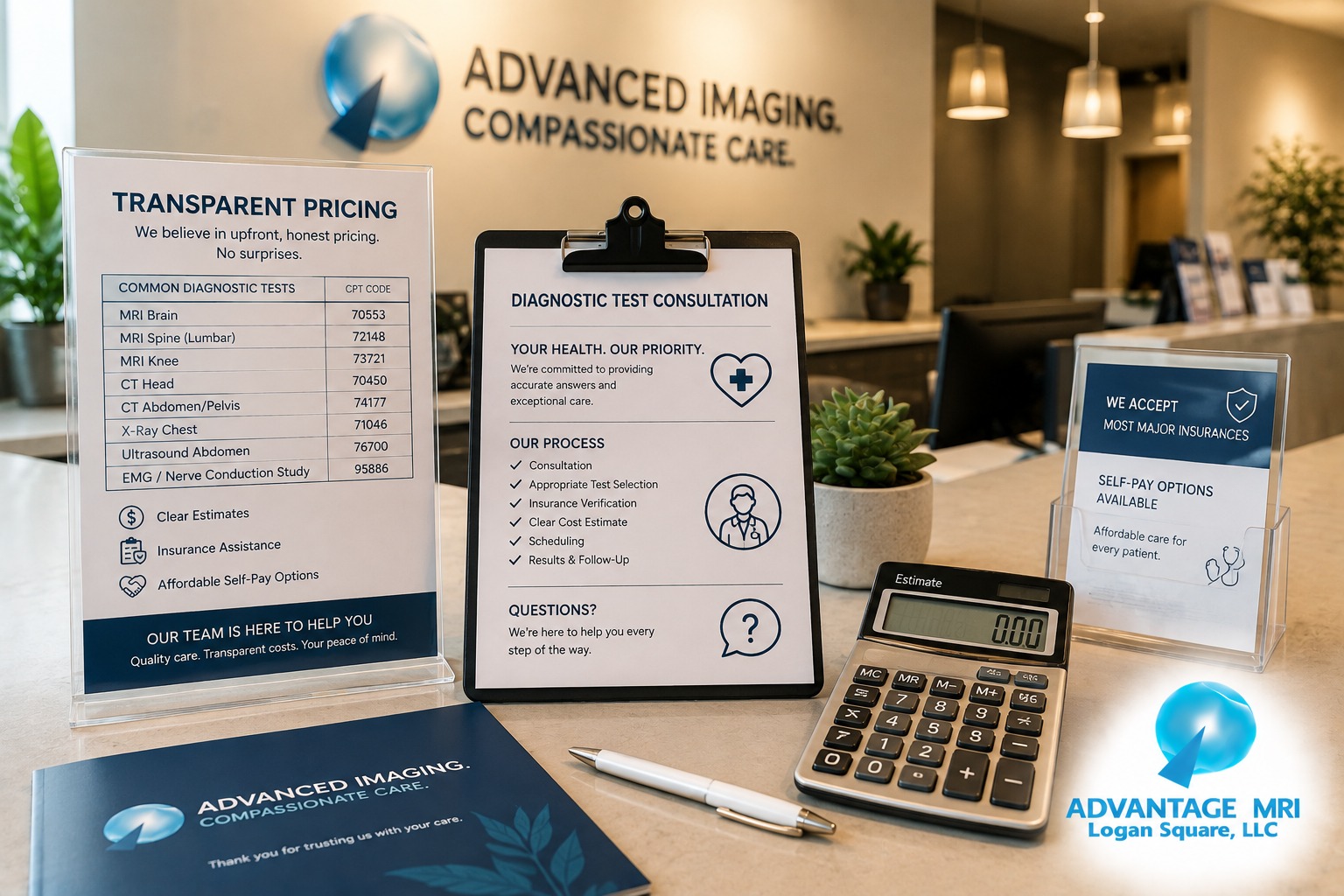
At Advantage MRI we keep our pricing transparent. Before you schedule anything you can find out what your specific testing will cost, whether that the emg alone or the full emg ncv test price with both parts included. Nobody likes a surprise bill after a medical test and we’d rather you know upfront.
Check out our EMG Testing page for more on how we structure pricing for this specific test.
Does Insurance Cover EMG Testing for Lower Back Pain
Most insurance plans do cover emg testing when it ordered by a doctor and considered medically necessary. That usually means your doctor has documented symptoms like leg weakness, numbness or pain that hasn’t responded to basic treatment and the emg test is being used to confirm a diagnosis or guide a treatment plan.
Where it gets tricky is the out of pocket side. Even with insurance coverage you might still owe a copay or have to meet your deductible first, depending on your specific plan. It worth calling your insurance provider ahead of time to ask exactly what your plan covers and what you’d be responsible for.
If you’re uninsured or your plan doesn’t cover the test, cash price options exist. And in a lot of cases the cash price for diagnostic tests like this ends up being more predictable than trying to navigate insurance paperwork, since you know the number going in.
Have questions about your specific coverage? Our team can help you understand your options before your appointment. Contact us and we’ll walk you through it.
What Happens During a Lower Back EMG Test
Knowing what actually happens during the test tends to ease most of the nerves people have going in.
Before your appointment. Wear loose comfortable clothing since the technician will need access to the area being tested, usually your lower back and one or both legs. Avoid lotions or oils on your skin that day. Your referring doctor will have already sent over the order specifying which limbs and muscles need testing.
During the test. A thin needle electrode gets inserted into specific muscles, one at a time. It sounds worse than it feels. Most patients describe a quick pinch, similar to getting blood drawn, followed by mild discomfort as the needle moves slightly to record signals from different muscle fibers. The specialist will ask you to relax the muscle and then contract it, comparing both readings. This part of the test usually takes anywhere from 30 minutes to an hour depending on how many muscles need checking.
If your doctor also ordered a nerve conduction study, that part uses small electrical stimulation through electrodes placed on your skin rather than needles, so it feels more like a mild tingling than anything sharp.
After the test. There no downtime needed. You might have slight soreness at the needle sites for a day or so but you can drive yourself home and go about your day normally. A specialist will interpret the results and send a report to your referring doctor, who will then go over what it means for your treatment options.
EMG Test vs Nerve Conduction Study
People mix these two up constantly and honestly it makes sense since they’re often done back to back in the same appointment.
An emg test looks at the muscle itself and how it responds electrically. A nerve conduction study or NCV, looks at how fast and how well electrical signals travel along the nerve. Muscle problems and nerve problems can cause similar symptoms like weakness or numbness, so doctors often want both pieces of information before landing on a diagnosis.
For lower back pain that radiates into a leg, this combo helps tell the difference between something happening in the muscle versus a nerve being compressed somewhere along its path, whether that near the spine or further down the limb. Conditions like peripheral neuropathy or nerve damage from a herniated disc show up differently on each test, which is exactly why doing both gives a fuller picture.
Curious about the nerve conduction side specifically? Visit our Nerve Conduction Study page for more detail.
Signs You Might Need an EMG Test
Not every backache needs this level of testing. But certain symptoms tend to push doctors toward ordering one.
That includes numbness or tingling running down one leg, muscle weakness that makes it hard to lift your foot or grip something normally and chronic lower back pain that hasn’t improved after weeks of rest, physical therapy or other conservative treatment. Symptoms affecting one limb versus spreading to multiple limbs also changes how a doctor approaches testing, since that pattern can point toward different underlying causes.
If you’ve been dealing with pain that radiates or weakness that starting to interfere with daily tasks, it worth bringing it up with your doctor. An emg test won’t diagnose everything on its own but it gives your healthcare provider real data to work with instead of guessing.
Why Choose Advantage MRI for EMG Testing in Chicago
Advantage MRI is a diagnostic imaging center in the Hermosa neighborhood of Chicago and our approach to emg testing reflects the same standard we hold across all our diagnostic services.
Our facility is ACR accredited, meaning we meet the standards set by the American College of Radiology for imaging quality and safety. Our radiologists are board certified, including Dr. Gregory T. Goldstein, a board certified diagnostic radiologist with a background in orthopedic and neurologic imaging. Dr. Goldstein founded MetisMD and created the Connected RadiologySM approach, which focuses on coordinated communication between radiologists and referring physicians so patients get faster, clearer answers. You can read more about his background on our About Us page.
Beyond the credentials, we keep the actual patient experience simple. That means transparent cash pricing so you know your emg testing cost before you walk in, an on site pharmacy and IV treatment capability for patients who need it. We also work directly with referring physicians to keep scheduling and reporting fast, so you’re not waiting weeks for answers about your own body.
Ready to schedule? You can book an appointment online or give us a call.
Frequently Asked Questions
How much does an emg test cost for lower back pain?
Emg test costs depend on how many limbs are tested and whether it combined with a nerve conduction study. Cash pricing is available and our team can give you an exact number before you schedule.
Is emg testing covered by insurance?
Most insurance plans cover emg testing when a doctor orders it as medically necessary. You may still owe a copay or need to meet your deductible depending on your specific plan.
Does an emg test hurt?
Most patients describe the needle electrode as a quick pinch similar to a blood draw, with mild discomfort as it moves between muscle fibers. It generally well tolerated and doesn’t require any downtime afterward.
How long does a lower back emg test take?
The muscle testing portion typically takes 30 minutes to an hour. If a nerve conduction study is included in the same visit, expect the full appointment to run a bit longer.
What the difference between emg and ncv testing?
An emg test measures electrical activity in muscles using a needle electrode. An ncv test measures how fast signals travel along a nerve using surface electrodes and mild electrical stimulation. They’re often done together for a complete picture.
What conditions can an emg test diagnose?
Emg testing helps diagnose nerve and muscle disorders including nerve compression from a herniated disc, peripheral neuropathy and conditions like carpal tunnel syndrome when testing other limbs. It doesn’t diagnose everything but it gives your doctor real data on nerve and muscle function.
Do I need a referral for emg testing?
Yes. Emg testing requires an order from your doctor specifying which limbs and muscles need to be checked based on your symptoms.
How soon will I get my emg test results?
Results are interpreted by a specialist and sent to your referring doctor, who will then discuss what they mean for your treatment plan. Turnaround time depends on your provider but Advantage MRI prioritizes fast reporting.
Is emg ncv test price different from a standalone emg?
Yes. The combined emg ncv test price is generally higher than a standalone emg since you’re getting two separate diagnostic tests in one visit, though many patients find the combined pricing more practical than scheduling two appointments.
Where can I get an emg test near Chicago?
Advantage MRI offers emg testing at our location in the Hermosa neighborhood of Chicago, with transparent pricing and fast scheduling for both self pay and insured patients.
Conclusion
Lower back pain that spreads into your leg deserves a real answer, not just guesswork. An emg test gives your doctor a clear look at how your muscles and nerves are actually functioning and knowing the cost and process ahead of time takes a lot of the anxiety out of it. If your doctor has recommended this test, understanding what to expect and what it costs puts you in a better position to move forward with confidence.
Contact Us
- Address: 2008 N Pulaski Rd, Chicago, IL 60639
- Phone: (773) 227 9777
- Email: info@advantagemri.org
For reliable, advanced diagnostic imaging you can trust, call Advantage MRI today or schedule your appointment online.
Follow us on social media for the latest health tips, diagnostic imaging updates and clinic news: Facebook | Instagram | LinkedIn.