Health & Imaging
EMG Test Near Me: Your Guide to Nerve and Muscle Testing in Chicago IL
If your hand keeps going numb or your grip feels weaker than it used to be your doctor may have mentioned an EMG test. Maybe you searched for an emg test near me and landed here trying to figure out what actually happens during the exam. That is a fair question and one worth answering plainly before you book anything.
An EMG test looks at how well your nerves and muscles talk to each other. It is one of the more reliable ways doctors diagnose nerve and muscle disorders and it does not require surgery or long recovery time. At Advantage MRI in the Hermosa neighborhood of Chicago we perform EMG and nerve conduction testing for patients dealing with numbness tingling weakness and unexplained pain in the arms legs hands or feet.
This guide walks through what the test measures how it works what to expect and how to find a testing center that gets you answers without weeks of waiting.
Need to Schedule a Diagnostic Appointment?
Whether you need an MRI, ultrasound, X-ray, or another diagnostic service, Advantage MRI is here to help you take the next step in your healthcare journey.
Submit your appointment request online, and our team will contact you to confirm your visit.
Book Your Appointment →What Is an EMG Test and Why Doctors Order It
Electromyography or EMG is a diagnostic exam that measures the electrical activity in your muscles. Nerves send electrical signals to tell muscles when to contract and when to rest. When something interrupts that signal whether it is nerve damage a pinched nerve or a muscle disorder the pattern of electrical activity changes. An EMG picks up on that.
A physician usually orders an EMG when someone reports muscle weakness cramping twitching or pain that does not have an obvious cause. It is also common after an injury or when someone has a condition like diabetes that can affect the nerves over time.
Here is the thing though. EMG on its own only tells part of the story. Most physicians pair it with a nerve conduction study to get a full picture of both muscle and nerve function. We will get into that difference in a moment.
What an EMG test can help diagnose:
| Condition | What EMG Detects |
|---|---|
| Carpal tunnel syndrome | Nerve compression at the wrist |
| Peripheral neuropathy | Nerve signal disruption in hands and feet |
| Radiculopathy | Nerve root irritation from spine issues |
| Muscle disorders | Abnormal electrical activity in muscle tissue |
| ALS and motor neuron disease | Loss of nerve signal to muscle |
| Sciatica related nerve compression | Nerve conduction slowing along the sciatic pathway |
None of this replaces a full evaluation from your physician. The test gives your doctor data. Your doctor turns that data into a diagnosis and treatment plan.
EMG Test vs Nerve Conduction Study: What Is the Difference
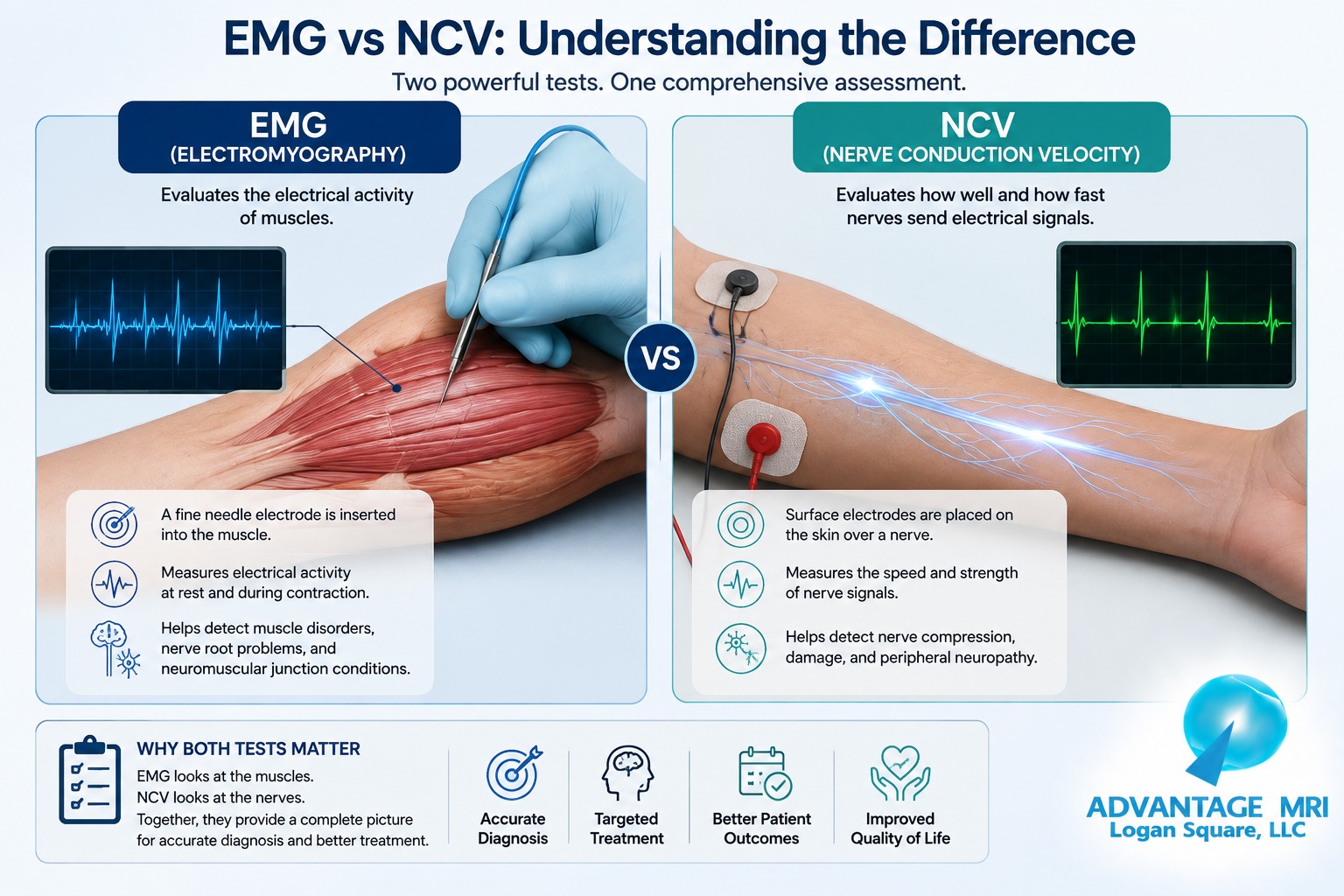
People search for emg ncv test near me a lot and honestly the confusion makes sense. These two tests are usually done back to back in the same visit but they measure different things.
EMG uses a thin needle electrode inserted into the muscle to record electrical activity at rest and during movement. Nerve conduction study or NCV uses surface electrodes taped to the skin and sends a small electrical pulse to measure how fast a nerve signal travels along a nerve pathway. Slower signals often point to nerve damage or compression.
| Feature | EMG | Nerve Conduction Study (NCV) |
|---|---|---|
| What it measures | Muscle electrical activity | Speed of nerve signals |
| Method | Needle electrode in muscle | Surface electrodes on skin |
| Duration | 20 to 40 minutes | 15 to 30 minutes |
| Common use | Detecting muscle and nerve root issues | Detecting nerve compression or damage |
| Sensation | Brief discomfort during needle insertion | Mild tingling from electrical pulse |
Doctors often order both because muscle problems and nerve problems can look similar from the outside. Combining the two tests narrows down where the actual issue is coming from. If your referral mentions our nerve conduction study service that is exactly what this second test refers to.
Signs You Might Need an EMG Test Near Me
Not every ache needs an EMG. But certain symptoms tend to show up again and again in patients who end up needing one.
Numbness and tingling that will not go away especially in the hands or feet is one of the more common reasons people come in. Muscle weakness that seems to be getting worse rather than better is another. So is unexplained muscle twitching or cramping that happens even when you are resting.
A lot of patients also come in after being told they might have carpal tunnel syndrome sciatica or a pinched nerve in the neck or lower back. And for people managing diabetes for years an EMG can help catch early signs of neuropathy before it progresses further.
If you have had these symptoms for more than a couple weeks it is worth bringing up with your physician. They will decide whether EMG and nerve conduction testing makes sense for your situation.
What Happens During EMG Testing
Before your appointment. Your physician sends a referral and Advantage MRI schedules your visit. There is not much prep required though we will cover a few small things in the next section.
During the procedure. A trained technician or physician places small electrodes on the skin over the muscle or nerve being tested. For the EMG portion a thin needle electrode is inserted into specific muscles. You will be asked to relax the muscle and then contract it so the machine can record electrical activity at rest and during activity. For the nerve conduction portion small electrical pulses are sent through surface electrodes and the machine measures how fast that signal travels.
The whole combined exam usually takes between 30 and 60 minutes depending on how many muscles and nerves need testing.
After the test. There is no downtime. You can drive yourself home and go back to your normal day. Some patients notice mild soreness or a small bruise where the needle electrode was placed and that typically fades within a day or two.
Results get reviewed by a board certified physician and sent to your referring doctor who will go over what the findings mean for your specific case.
Is EMG Testing Painful
Short answer: mostly no with brief moments of mild discomfort.
The nerve conduction part feels like a quick tingling or muscle twitch each time the pulse is sent. It is not comfortable exactly but it passes fast. The needle portion of the EMG is where most people feel a little more. It is often described as similar to a quick pinch or a mild ache while the needle is in place especially when you contract the muscle.
For a lot of people the anticipation is worse than the actual test. Discomfort is usually brief and localized and it does not linger much past the appointment itself. If you have specific pain concerns talk to your technician beforehand. They do this every day and can walk you through what to expect for your particular case.
Finding a Trusted EMG Testing Center in Chicago
Not every emg testing center near me search result gives you the same experience. Large hospital systems can mean longer wait times and less direct communication with the physician reading your results. That is a real frustration for a lot of patients who just want answers.
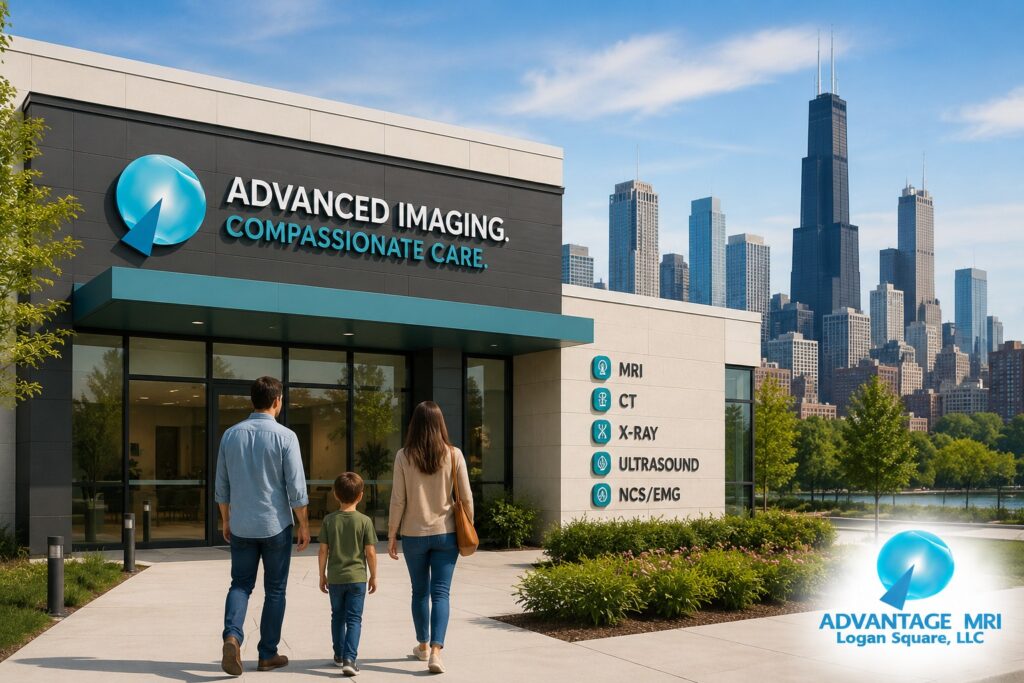
Advantage MRI is a Chicago based diagnostic imaging center in the Hermosa neighborhood built around faster scheduling and direct physician oversight. Our center is ACR accredited which means we meet the same quality and safety standards recognized by the American College of Radiology.
Our EMG and nerve conduction testing is overseen by Dr. Gregory T. Goldstein MD a board certified diagnostic radiologist with a background in orthopedic and neurological imaging. He is also the founder of MetisMD and the creator of Connected RadiologySM a model built around faster communication between imaging centers and referring physicians. That background matters here because nerve and muscle testing depends heavily on accurate interpretation.
We also offer an on site pharmacy and IV treatment capability which is not something every independent imaging center provides. If your physician has ordered EMG testing along with other diagnostics we can usually coordinate everything under one roof.

How to Prepare for Your EMG and Nerve Conduction Study
Preparation for this exam is fairly simple compared to a lot of imaging tests.
Wear loose comfortable clothing that allows easy access to the arms or legs being tested. Skip lotion or oil on your skin the day of the test since it can interfere with electrode placement. Let your technician know about any medications you are taking especially blood thinners and mention if you have a pacemaker or bleeding disorder before the test begins.
Eating and drinking normally beforehand is fine. There is no fasting required for this exam. If you smoke try to avoid it for a few hours before your appointment since nicotine can sometimes affect nerve readings slightly.
Bring your insurance information and physician referral to your visit. If you have questions about coverage our team can help you sort that out before your appointment date.
EMG Testing for Chicago Patients
Advantage MRI sits in the Hermosa neighborhood on the northwest side of Chicago giving patients from Belmont Cragin Logan Square and the surrounding areas a closer option than downtown hospital systems. A lot of patients tell us they chose us specifically because the wait times were shorter and scheduling was easier to work around a job or family schedule.
If your doctor has referred you for emg testing near me or you are searching for an emg test chicago option closer to home reach out to our team. We coordinate directly with referring physicians so your results reach the right people quickly.
You can schedule your appointment online or contact our office directly if you have questions about your referral or what to bring.
Frequently Asked Questions
What does an EMG test show?
An EMG test shows how well your muscles respond to nerve signals. It measures electrical activity in muscle tissue both at rest and during movement which helps identify nerve damage muscle disorders or conditions like carpal tunnel syndrome and radiculopathy.
Does an EMG test hurt?
Most patients feel mild discomfort rather than significant pain. The nerve conduction portion causes brief tingling from the electrical pulse and the needle EMG portion can feel like a quick pinch or ache while the muscle is being tested.
How long does an EMG test take?
A combined EMG and nerve conduction study usually takes between 30 and 60 minutes depending on how many muscles and nerves your physician wants evaluated.
What is the difference between EMG and NCV?
EMG measures electrical activity inside the muscle using a needle electrode. Nerve conduction study or NCV measures how fast electrical signals travel along a nerve using surface electrodes on the skin. They are often done together for a complete picture.
How do I prepare for EMG testing?
Wear loose clothing avoid lotion on your skin the day of the test and tell your technician about any medications blood thinners or medical devices like a pacemaker before the exam begins.
Can EMG detect nerve damage or just muscle issues?
EMG primarily detects muscle related electrical activity but when combined with a nerve conduction study it helps identify nerve damage compression and signal delays as well.
Who performs EMG and nerve conduction studies?
These tests are performed by trained technicians and interpreted by physicians experienced in neuromuscular diagnostics. At Advantage MRI our testing is overseen by a board certified diagnostic radiologist.
Is EMG testing near me covered by insurance?
Coverage depends on your individual insurance plan and whether the test is ordered by a referring physician. Our office can help verify your benefits before your scheduled appointment.
What conditions get diagnosed through EMG testing?
EMG and nerve conduction testing commonly helps diagnose carpal tunnel syndrome peripheral neuropathy radiculopathy sciatica related nerve compression and certain muscle disorders.
How soon will I get my EMG test results?
Results are reviewed by a physician and typically sent to your referring doctor within a few business days. Your doctor will discuss the findings and next steps with you directly.
Conclusion
Numbness weakness and unexplained nerve pain are frustrating to live with and even more frustrating when you cannot get a clear answer fast. EMG and nerve conduction testing gives your physician real data about what is happening between your nerves and muscles so you are not left guessing. If your doctor has referred you for testing or you are simply trying to understand your symptoms better a local center with direct physician oversight can make the process a lot less stressful.
This article is for general information only and is not a substitute for professional medical advice diagnosis or treatment. Always talk to your physician about your specific symptoms and testing needs.
For reliable advanced diagnostic imaging you can trust call Advantage MRI today or schedule your appointment online.
Contact Us
- Address: 2008 N Pulaski Rd, Chicago, IL 60639
- Phone: (773) 227 9777
- Website: advantagemri.org
Follow us on social media for the latest health tips, diagnostic imaging updates and clinic news: Facebook | Instagram | LinkedIn.