Health & Imaging
How Much Does a Nerve Conduction Study Cost

If your doctor just told you that you need a nerve conduction study, chances are the first question in your head wasn’t about electrodes or nerve cells. It was about money. What does a nerve conduction study actually cost and will your insurance cover it? That’s the question most people search for and it’s the one this article answers.
A nerve conduction study, often called NCS, checks how well your nerves send electrical signals through your body. Doctors order it when someone has numbness, tingling or muscle weakness in an arm or leg that won’t go away. It’s one of the more common tests used to figure out what’s going on with the peripheral nervous system and here in Chicago patients at Advantage MRI in the Hermosa neighborhood ask about pricing almost every single day.
We’re going to walk through the actual cost of a nerve conduction study, the CPT codes billed for it, what makes the price go up or down and how it compares to an EMG test. No fluff, just the numbers and facts you came here for.
Need to Schedule a Diagnostic Appointment?
Whether you need an MRI, ultrasound, X-ray, or another diagnostic service, Advantage MRI is here to help you take the next step in your healthcare journey.
Submit your appointment request online, and our team will contact you to confirm your visit.
Book Your Appointment →What Is a Nerve Conduction Study
A nerve conduction study measures how fast and how strong electrical signals travel through a nerve. Small electrode patches get placed on the surface of your skin, usually over the nerve being tested. A mild electrical stimulation is sent through the nerve and a machine records the speed and intensity of the response. The results show up displayed on a monitor almost instantly.
This test helps identify issues like nerve damage, nerve compression syndromes and problems with how nerve signals travel to your brain and spinal cord. It’s a real diagnostic test, not a guess. Doctors use it to diagnose conditions such as carpal tunnel syndrome, peripheral neuropathy and other nerve related disorders.
How It Differs From EMG Testing
People mix up nerve conduction studies and EMG testing all the time and honestly it’s an easy mix up to make since they’re often done back to back. An NCS looks at how electrical signals move through a nerve. An EMG test, short for electromyography, looks at the electrical activity in your muscles themselves using a thin electrode.
Here’s the thing. A lot of patients get both tests in the same visit because together they give a fuller picture of nerve and muscle function. A neurologist or physical medicine doctor will usually order both when trying to pin down whether a problem is coming from the nerve, the muscle or somewhere in between.
How Much Does a Nerve Conduction Study Cost
This is what most people are really here for, so let’s get into it. The cost of a nerve conduction study depends heavily on where you live, whether you have insurance and how many nerves get tested. In most cases, a standalone nerve conduction study can run anywhere from 150 dollars to over 500 dollars per limb when paid out of pocket. When it’s billed through insurance, your actual cost usually comes down to your copay, deductible status and coinsurance percentage.
If the test is combined with an EMG test, which happens often, the total cost tends to land higher since you’re paying for two separate diagnostic services performed in one visit. For a lot of people, private nerve conduction studies done at an independent imaging center end up costing less than the same test performed inside a hospital setting, mainly because hospitals tack on facility fees that private centers don’t charge.
Below is a general breakdown to help you understand where the price differences usually come from. These are general ranges and not a quote, since actual pricing depends on your specific case and coverage.
| Payment Scenario | Typical Price Range | Notes |
|---|---|---|
| Self pay, no insurance | 150 to 500+ dollars per limb | Price depends on number of nerves tested |
| Insured, deductible not met | Full contracted rate until deductible met | Contracted rate is usually lower than self pay |
| Insured, deductible met | Copay or coinsurance amount only | Often 20 to 50 dollars depending on plan |
| Medicare | Set reimbursement rate per CPT code | Patient responsible for 20 percent coinsurance typically |
That table gives you a rough map but your best move is always to call your insurance provider directly and ask about your specific plan’s coverage for nerve conduction studies before your appointment.
Nerve Conduction Study CPT Code Explained
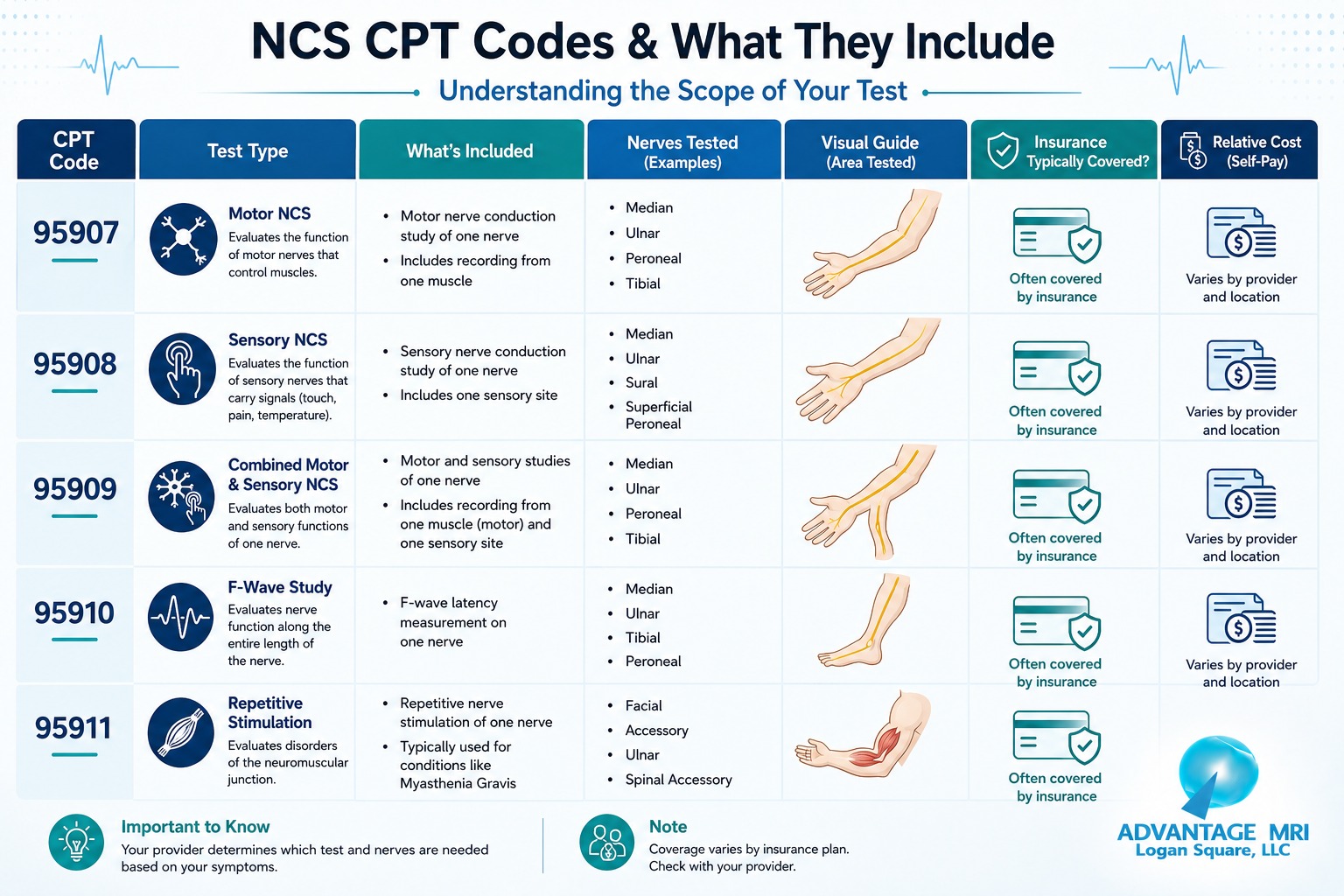
Insurance companies and healthcare providers don’t bill using plain English descriptions. They use CPT codes, which stands for Current Procedural Terminology. Each nerve tested during your study gets billed under its own code, which is part of why the total cost can shift so much from patient to patient.
The most common CPT codes used for nerve conduction studies fall in the 95907 through 95913 range and these codes are grouped based on how many nerves get studied during the visit. A separate code, 95886, is often used when an EMG test is performed alongside the NCS to evaluate muscle function.
Common CPT Codes Used
| CPT Code | What It Covers |
|---|---|
| 95907 | Nerve conduction study, 1 to 2 nerves |
| 95908 | Nerve conduction study, 3 to 4 nerves |
| 95909 | Nerve conduction study, 5 to 6 nerves |
| 95910 | Nerve conduction study, 7 to 8 nerves |
| 95911 | Nerve conduction study, 9 to 10 nerves |
| 95912 | Nerve conduction study, 11 to 12 nerves |
| 95913 | Nerve conduction study, 13 or more nerves |
| 95886 | Needle EMG, limited or complete, done with nerve conduction study |
Your healthcare provider chooses the code based on how many nerves your specific condition requires them to test, not the other way around. So if your doctor suspects carpal tunnel syndrome, they might only need to check one or two nerves in your wrist and hand. But if they’re investigating something broader like peripheral neuropathy affecting both legs, more nerves get tested and the code, along with the price, moves up.
What Affects the Price of an NCS Test
A few different things push the price of a nerve conduction study up or down and it’s worth knowing them before your appointment so nothing feels like a surprise.
Number of Nerves Tested
This is the biggest factor. Testing one nerve in one arm costs less than testing multiple nerves across both arms and legs. Your doctor decides this based on your symptoms and medical history, not based on cost, so don’t expect to negotiate the number down.
Combined EMG and NCS Pricing
When an EMG test gets added to your nerve conduction study, you’re looking at two procedures billed together. This combined approach is common for diagnosing conditions like carpal tunnel syndrome and peripheral neuropathy at the same time, since the two tests complement each other. It costs more than an NCS alone but it also gives your doctor a more complete diagnosis in a single visit instead of two separate appointments.
Other things that can affect price include whether the test is done at a hospital versus an independent center, your specific insurance plan’s contracted rates and your geographic location. Chicago pricing will look different from pricing in a smaller market and even within Chicago, rates vary between providers.
What Happens During a Nerve Conduction Study
Knowing what to expect can take a lot of the anxiety out of the appointment. The test itself usually takes anywhere from 15 minutes to an hour depending on how many nerves are being checked.
A technician or physician places electrode patches on the surface of your skin over the nerve being studied. A mild electrical stimulation is then sent through the nerve and you might feel a quick tingle or a small muscle twitch. It’s not usually described as painful, more like a brief zap similar to static shock. The machine records how fast the electrical signals travel and how strong the response is and that data gets displayed on a monitor for the technician to review.
If you have a pacemaker or cardiac defibrillator, tell your healthcare provider before the test since it can affect how the study is performed. Your medical history and current symptoms guide exactly which nerves get tested and how the technician approaches your specific case.
Conditions a Nerve Conduction Study Helps Identify
Doctors order nerve conduction studies to help diagnose a range of nerve disorders and muscle disorders. Some of the more common conditions include carpal tunnel syndrome, peripheral neuropathy, nerve compression syndromes affecting the spinal cord or nerve roots and Guillain Barré syndrome.
The test essentially tells your doctor whether a nerve is functioning normally, slowed down or not conducting signals at all. That information helps your healthcare provider figure out where the problem is coming from and what kind of treatment plan might help. It’s not a treatment itself. It’s a piece of the puzzle that helps your doctor make an informed decision about next steps.
This article and the information in it is meant to help you understand the test and what it costs. It is not a substitute for medical advice from your doctor. Always talk to a healthcare provider about your specific symptoms and what diagnostic tests are right for you.
Private Nerve Conduction Studies vs Hospital Pricing
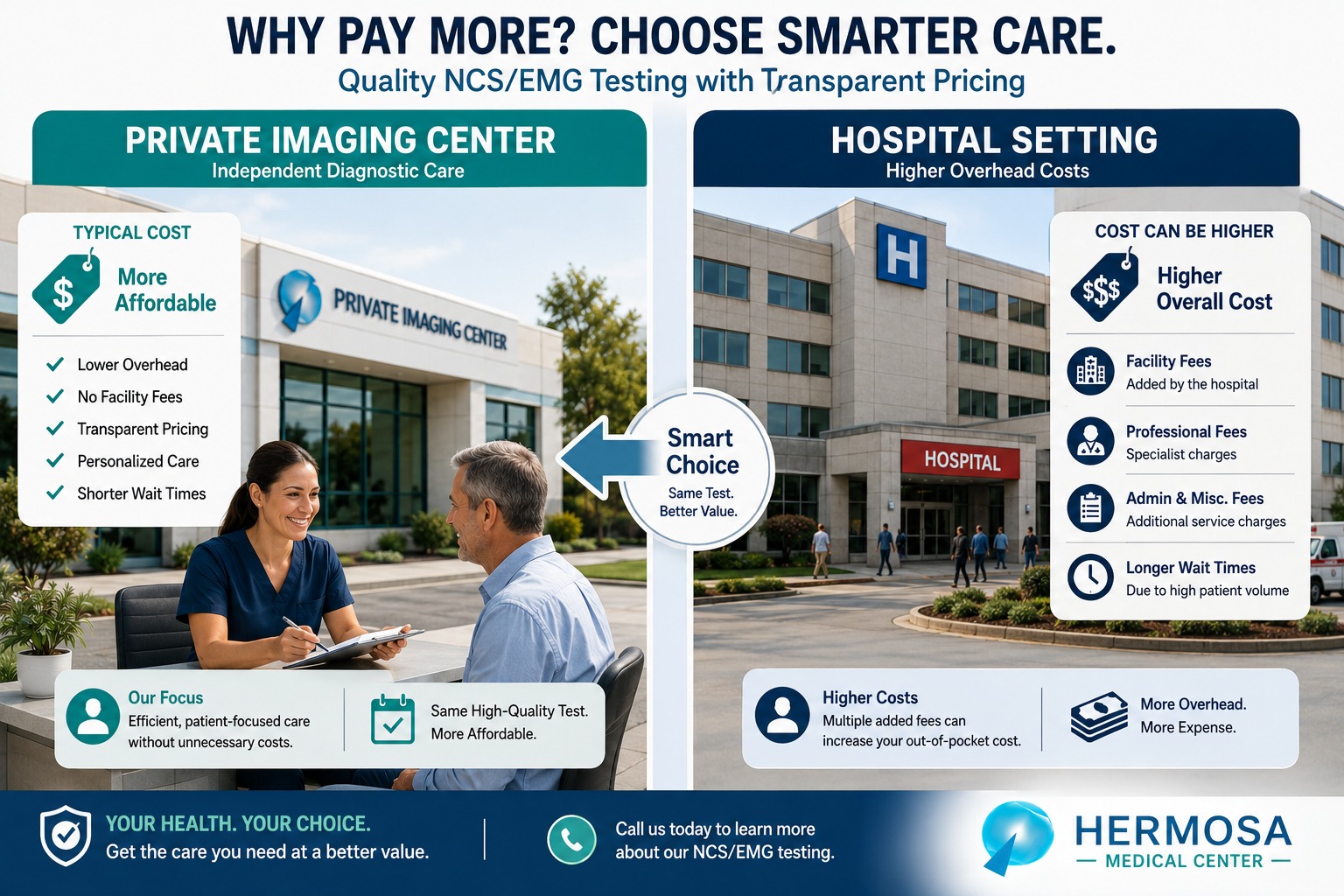
A lot of patients don’t realize they have a choice in where they get tested. Private nerve conduction studies performed at independent diagnostic centers often come with lower overall costs compared to the same test done inside a hospital system. Hospitals frequently add a separate facility fee on top of the actual test cost and that fee alone can add hundreds of dollars to your bill.
Independent imaging centers, on the other hand, tend to bill only for the service itself. That’s one reason patients across Chicago look for private nerve conduction studies rather than automatically booking through a hospital network. It’s worth asking upfront how a facility bills before you schedule, since that one question can save you a real amount of money.
Why Choose Advantage MRI for Your Nerve Conduction Study
Advantage MRI is a diagnostic imaging center located in the Hermosa neighborhood of Chicago and nerve conduction studies are one of the core services offered on site. The center is ACR accredited and testing is overseen with input from board certified sub specialized radiologists including Dr. Gregory T. Goldstein, MD, a board certified diagnostic radiologist with a background in orthopedic and neurological imaging. Dr. Goldstein founded MetisMD and created the Connected RadiologySM approach, which focuses on coordinated communication between imaging centers and referring physicians.
Patients scheduling a nerve conduction study at Advantage MRI also have access to an on site pharmacy and IV treatment capability if needed, along with fast scheduling and fast reporting back to referring physicians. For patients whose doctors want a combined evaluation, EMG testing is available at the same location, which means no bouncing between different facilities for related tests. The center also offers other diagnostic services including ultrasound, MRI imaging and digital x ray under one roof.
How to Book Your Appointment Online
Scheduling a nerve conduction study at Advantage MRI doesn’t require jumping through hoops. You can book your appointment online directly through the website or call the office if you’d rather talk to someone about your specific situation and insurance coverage first. Either way, bring your doctor’s referral and any relevant medical history to your visit so the technician has full context going in.
Frequently Asked Questions
How much does a nerve conduction study cost without insurance?
Without insurance, a nerve conduction study typically costs between 150 and 500 dollars or more per limb, depending on how many nerves your doctor needs to test. Combined testing with an EMG raises that total. Prices vary by provider, so it’s worth calling ahead for a direct quote based on your situation.
What is the CPT code for a nerve conduction study?
Nerve conduction studies are billed under CPT codes 95907 through 95913, with the specific code depending on how many nerves are tested during your visit. When an EMG is performed alongside it, code 95886 is typically added to the claim.
Is EMG the same as a nerve conduction study?
No. A nerve conduction study measures how electrical signals travel through a nerve, while an EMG test measures electrical activity happening inside your muscles. They’re often done together because they answer different but related questions about nerve and muscle function.
Does insurance cover nerve conduction studies?
Most insurance plans do cover nerve conduction studies when a doctor orders one to diagnose a medical condition, though your out of pocket cost depends on your deductible, copay and coinsurance. Insurance coverage and plan details vary, so confirming with your provider before your appointment is the safest approach.
Does a nerve conduction study hurt?
Most patients describe the sensation as a quick tingle or small zap rather than actual pain. The electrical stimulation is mild and brief and any discomfort typically fades right after the stimulation stops.
How long do results take after a nerve conduction study?
Results are often available to your referring physician within a few days, though timing can depend on the facility and whether additional review is needed. Advantage MRI focuses on fast reporting back to referring doctors so treatment planning isn’t delayed.
What conditions does a nerve conduction study help diagnose?
It helps diagnose carpal tunnel syndrome, peripheral neuropathy, nerve compression syndromes and conditions like Guillain Barré syndrome, among other nerve disorders affecting the peripheral nervous system.
Can I get a nerve conduction study the same week in Chicago?
Advantage MRI offers fast scheduling for diagnostic tests including nerve conduction studies. Availability depends on current appointment openings, so it’s best to book online or call directly to check the soonest available slot.
What’s the price difference between EMG and NCS pricing?
An EMG test billed on its own generally costs less than a combined EMG and nerve conduction study visit, since a combined visit involves two separate diagnostic procedures. The exact price gap depends on how many nerves and muscle groups are tested.
Where is Advantage MRI located?
Advantage MRI is located in the Hermosa neighborhood of Chicago at 2008 N Pulaski Rd. You can find directions and additional details on the contact us page.
Conclusion
The cost of a nerve conduction study depends on a handful of real factors including how many nerves get tested, whether an EMG is added, your insurance coverage and where you choose to get tested. Private nerve conduction studies at independent centers often come in lower than hospital pricing once facility fees are factored in. Knowing the CPT codes and general price ranges ahead of time helps you walk into your appointment with fewer surprises and better questions for your insurance company.
Contact Us
- Address: 2008 N Pulaski Rd, Chicago, IL 60639
- Phone: (773) 227 9777
For reliable, advanced diagnostic imaging you can trust, call Advantage MRI today or schedule your appointment online.
Follow us on social media for the latest health tips, diagnostic imaging updates and clinic news: Facebook | Instagram | LinkedIn.