Health & Imaging
Why MRI Scanning Sound So Loud and What It Means for You

Walking into an MRI room for the first time can feel a little strange. The machine is huge, the room is cold and then the noise starts. Loud banging, clicking and buzzing sounds fill the room and if nobody warned you ahead of time, it can catch you off guard.
Here’s the thing. That noise isn’t a sign something’s wrong with the machine. It’s actually a normal part of how an mri scanning sound is generated during a scan. Once you understand where the sound comes from, the whole experience feels a lot less intimidating.
At Advantage MRI in Chicago’s Hermosa neighborhood, patients ask about this all the time. So let’s walk through why MRI machines make noise, what that noise actually sounds like, how long a scan takes, what side effects to expect and how MRI helps diagnose things like a slipped disk.
Need to Schedule a Diagnostic Appointment?
Whether you need an MRI, ultrasound, X-ray, or another diagnostic service, Advantage MRI is here to help you take the next step in your healthcare journey.
Submit your appointment request online, and our team will contact you to confirm your visit.
Book Your Appointment →Not a substitute for medical advice. This article is for general information only. Talk to your doctor about your specific imaging needs.
Why MRI Machines Make Noise
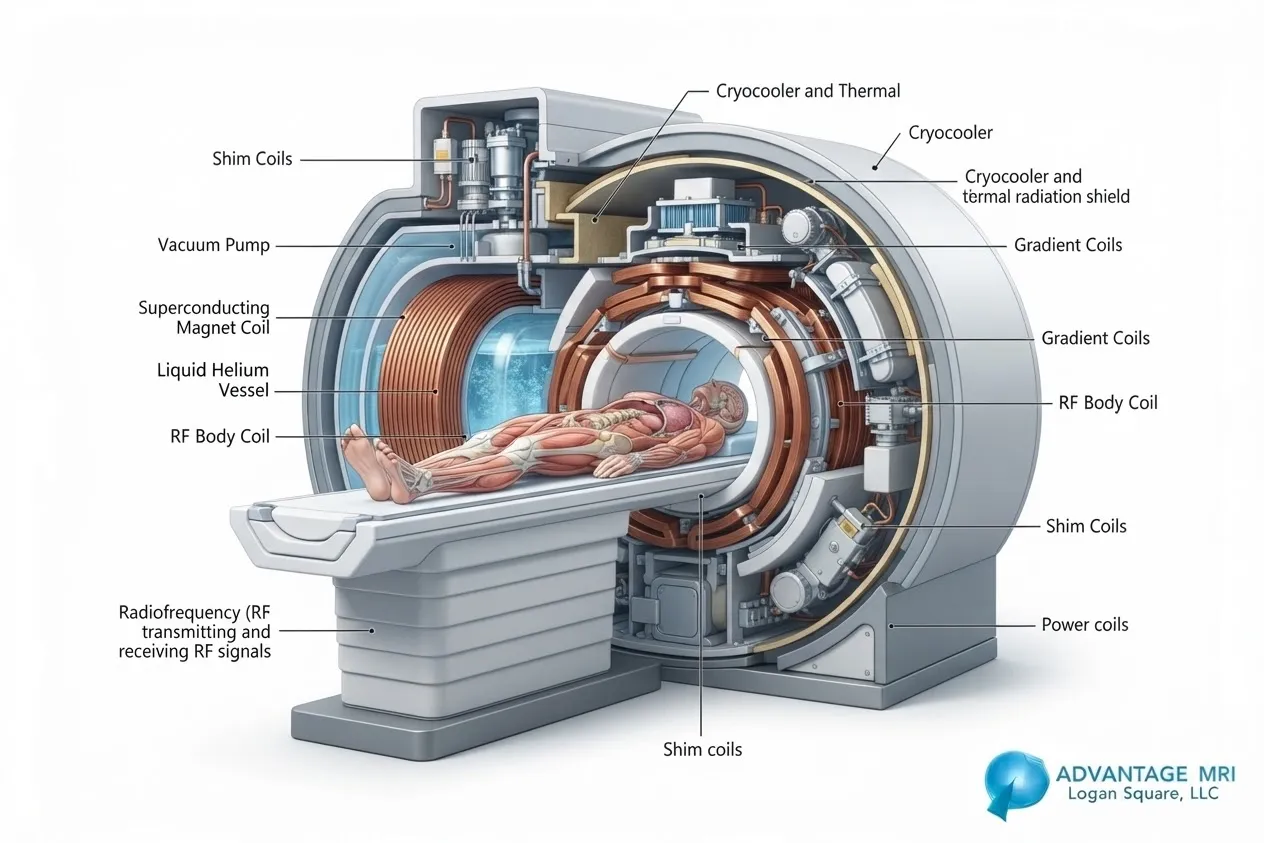
An MRI machine or magnetic resonance imaging scanner, doesn’t use radiation like an x ray does. Instead it uses a strong magnetic field along with radio waves to produce detailed images of the inside of your body. That process is what creates the noise.
Inside the mri machine, there’s a large primary magnet, usually a superconducting magnet cooled with liquid helium. Surrounding that magnet are smaller structures called gradient coils. These gradient coils are metal coils that create rapid changes in the magnetic field and that’s the part that actually makes the sound.
Here’s how it works in plain terms. Electrical currents run through the gradient coils in quick pulses. Those currents interact with the strong magnetic field of the scanner and that interaction makes the coils vibrate. When metal coils vibrate that fast inside a confined space, you get the loud thumping and clicking sounds patients hear.
Different pulse sequences use the coils in different patterns, so the noise changes depending on what part of the body is being scanned and what type of images the radiologist needs. That’s why an mri scan for the spine might sound different from one for the knee or the brain.
| What Causes the Noise | What You Hear |
|---|---|
| Main magnet | Constant low humming |
| Gradient coils switching on/off | Clicking |
| Electrical currents pulsing through coils | Buzzing |
| Coils vibrating rapidly | Loud banging |
What MRI Sounds Actually Sound Like
People describe MRI noises in a lot of different ways. Some say it sounds like a jackhammer a few feet away. Others compare it to a washing machine stuck on a hard cycle or a series of loud drumbeats.
The sound usually comes in bursts rather than one steady noise. You might hear a loud banging pattern for a minute or two, then a pause, then a different pattern of clicks or buzzing. That’s normal. Each burst usually lines up with a different pulse sequence the technologist is running to capture a specific type of image.
Some sequences, like echo planar imaging, tend to produce sharper and louder sounds because the gradient coils switch on and off very fast. Other sequences are quieter. So the noise level can shift throughout your scan and that’s expected.
If you want an idea of what to expect before your appointment, it can help to watch a video of a real mri scan online. A lot of patients say hearing the sound ahead of time made the actual scan feel much less surprising.
Is MRI Noise Safe for Your Ears
This is probably the most common question patients ask and it’s a fair one. MRI machines can produce sound levels that reach or exceed 100 decibels depending on the scanner and the sequence being used. For comparison, that’s in the same range as a loud power tool.
Because of that, hearing protection is a standard part of mri safety at any accredited imaging center. The American College of Radiology or ACR, along with guidance from RSNA and the FDA, supports using ear protection during every scan.
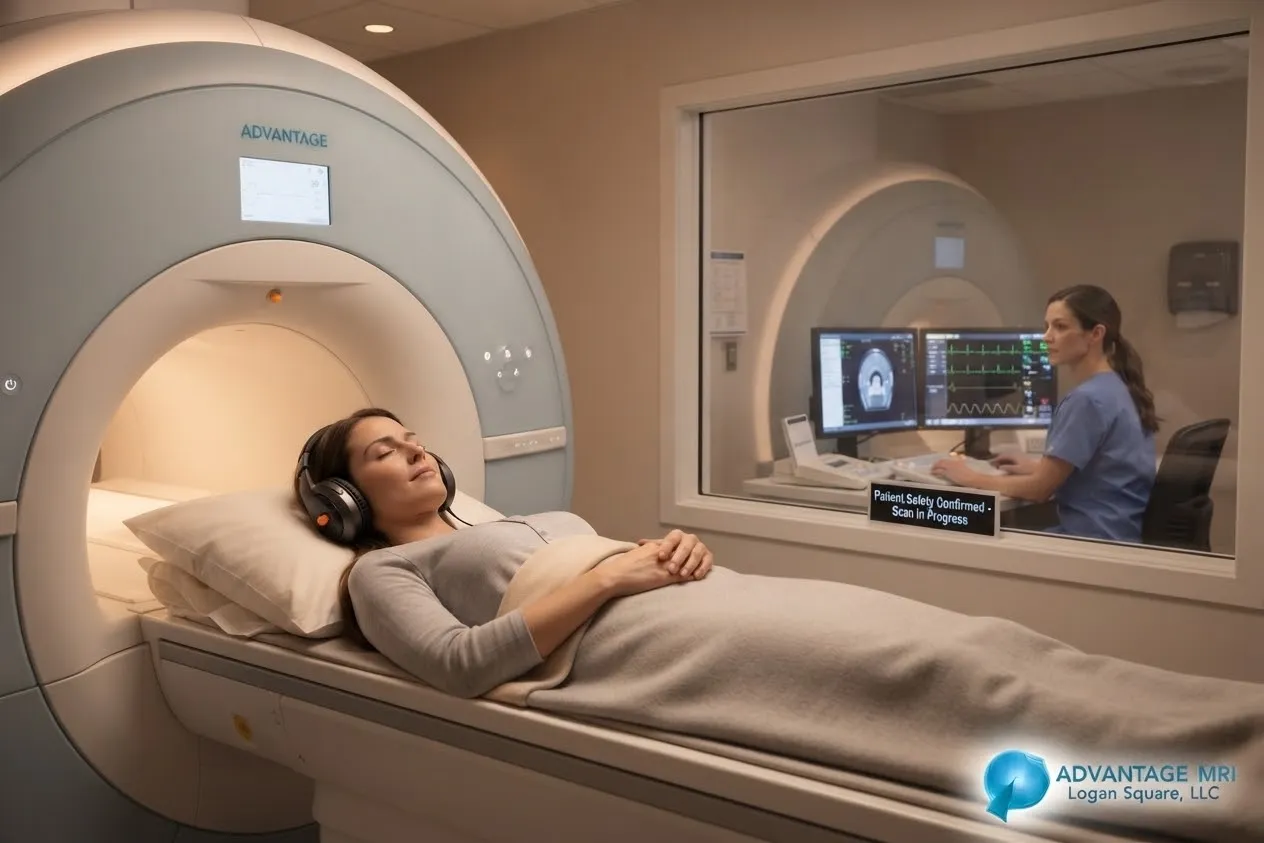
At Advantage MRI, patients get ear plugs or noise reducing headphones before entering the scan room. Some centers even let you listen to music through the headphones during the scan, which helps pass the time and also softens the impact of the noise.
Wearing hearing protection properly is a simple step but it matters. Foam ear plugs alone can reduce noise exposure significantly and headphones add another layer of protection on top of that. Your technologist will make sure everything fits correctly before starting the scan.
So no, the noise itself with proper protection is not expected to damage your hearing during a standard diagnostic mri procedure.
How Long Is the MRI Scan
Scan time depends heavily on the body part being imaged and how many sequences the radiologist needs. Most standard mri scans take somewhere between 20 and 60 minutes. Some quick scans of a single joint can finish in about 15 to 20 minutes, while more detailed scans, like ones involving contrast dye or multiple regions, can run closer to an hour.
Table suggestion: Add a table here with two columns, “Body Part” and “Typical Scan Time,” listing examples like brain (20 to 40 minutes), spine (30 to 45 minutes), knee (20 to 30 minutes) and full body or multiple region scans (45 to 60 minutes or more).
You’ll need to lie still for the full length of the scan, since movement can blur the images and sometimes means part of the scan has to be repeated. It sounds simple but staying still for that long takes a bit of practice for a lot of people. Bringing something to focus on mentally or just breathing slowly and steadily, can help the time pass.
MRI Scan Side Effects
For most people, an mri scan itself doesn’t cause any side effects. Since it doesn’t use radiation, there’s no radiation exposure to worry about, unlike an x ray or CT scan.
Some patients do experience mild and temporary reactions, though. These can include:
- Feeling a little anxious or claustrophobic inside the scanner, especially during longer scans
- Mild dizziness right after getting up from the table
- A warm or tingling feeling near metal implants, if applicable
- Temporary discomfort from lying still in one position
If contrast dye is used for the scan, a small number of patients report mild side effects like a cool sensation at the injection site, a metallic taste or slight nausea. Serious reactions to mri contrast are rare but your technologist will always ask about allergies and kidney function beforehand as a safety step.
If you have any metal implants, a pacemaker or other medical devices, it’s important to tell your care team before scheduling. Certain devices aren’t compatible with the strong magnetic field and safety screening is a standard part of every mri procedure.
Slipped Disk MRI Scan
A slipped disk, also called a herniated disk, happens when the soft cushion between spinal bones pushes out of place and presses on nearby nerves. This can cause pain, numbness or weakness that spreads down an arm or leg depending on where the disk is located.
MRI is considered one of the most reliable ways to look at soft tissue like spinal disks, nerves and the spinal cord itself. Unlike an x ray or digital x ray, which mainly shows bone, mri produces detailed images of the disks and surrounding soft tissue, which makes it useful for spotting a slipped disk and understanding exactly where it’s pressing on a nerve.
During a spine mri, you’ll lie on your back on the scan table while it slides into the scanner. The gradient coils and pulse sequences work the same way as they do for any other body part, so you can expect the same kinds of banging and clicking sounds during a spine scan. It usually takes around 30 to 45 minutes depending on how many views the radiologist needs.
Board certified radiologists, including sub specialized physicians trained in orthopedic and neurological imaging like Dr. Gregory T. Goldstein, MD, review these scans closely to look for disk herniation, nerve compression and related spinal changes. That level of review helps make sure findings are accurate and clearly explained back to your referring doctor.
Tips to Stay Comfortable During Your Scan
A few small things can make a real difference in how comfortable your scan feels.
Practice lying still at home for a few minutes before your appointment. It sounds almost too simple but knowing what stillness for 20 or 30 minutes actually feels like takes away some of the surprise.
Leave metal items at home or remove them before entering the scan room. That includes jewelry, since anything metal like jewelry can interfere with the magnetic field or heat up during the scan.
Ask your technologist questions before you go in. They can explain what sequence is running and roughly how long each noisy segment will last, which helps a lot of people feel more in control.
And if you’re someone who gets anxious in enclosed spaces, mention it ahead of time. Staff at Advantage MRI can talk through options that might help, including scheduling considerations or extra communication during the scan.
Frequently Asked Questions About MRi Scanning Sound
What is causing the loud noise during an MRI scan?
The noise comes from gradient coils inside the scanner. Electrical currents pulse through these coils and interact with the machine’s strong magnetic field, which makes the coils vibrate rapidly. That vibration is what creates the banging, clicking and buzzing sounds you hear.
How long is the MRI scan usually?
Most mri scans take between 20 and 60 minutes depending on the body part and number of sequences needed. Simple scans of one joint can finish faster, while detailed scans involving multiple areas or contrast dye take longer.
Is MRI noise safe for my hearing?
With proper hearing protection like ear plugs or headphones, mri noise is not expected to cause hearing damage. Sound levels can reach around 100 decibels or more, which is why ear protection is a standard part of every scan at accredited centers.
Who needs a slipped disk MRI scan?
Anyone with symptoms like back pain, numbness, tingling or weakness that spreads into an arm or leg may be referred for a spine mri. It’s often used when a doctor suspects a herniated or slipped disk pressing on a nerve.
Does an MRI scan hurt?
No, the scan itself is not painful. You might feel some discomfort from lying still for an extended period or a warm sensation if contrast dye is used but the imaging process itself doesn’t cause pain.
Can I listen to music during my MRI?
Many imaging centers, including ones offering noise reducing headphones, allow patients to listen to music during the scan. This can help mask the noise and make the time pass more easily.
What are the common MRI scan side effects?
Most patients don’t experience side effects. Some report mild anxiety, brief dizziness afterward or minor reactions to contrast dye if it’s used. Serious side effects are uncommon.
Do all MRI machines make the same sound?
No. Different scanners and different pulse sequences produce different sounds. Some sequences, like echo planar imaging, tend to be louder and sharper, while others are quieter.
Can I talk to the technologist during the scan?
Yes. Most mri machines have an intercom system, so you can talk to your technologist throughout the procedure if you have questions or need a break.
Is MRI better than X ray for diagnosing a slipped disk?
For soft tissue like spinal disks and nerves, mri generally provides more detail than a standard x ray, which is better suited for viewing bone. That’s why mri is commonly used when a slipped disk is suspected.
Conclusion
MRI noise can catch people off guard but it’s simply a normal part of how the machine’s gradient coils and magnetic field work together to capture detailed images. With proper hearing protection and a technologist guiding you through the process, most patients get through their scan without any trouble. Whether you’re scheduled for a spine mri to check for a slipped disk or another type of scan, knowing what to expect ahead of time makes the whole experience easier.
For reliable, advanced diagnostic imaging you can trust, call Advantage MRI today or schedule your appointment online.
Contact Us
- Address: 2008 N Pulaski Rd, Chicago, IL 60639
- Phone: (773) 227 9777
- Email: [please provide the exact business email to include here]
Follow us on social media for the latest health tips, diagnostic imaging updates and clinic news: Facebook | Instagram | LinkedIn.