Health & Imaging
How Long Does an EMG Test Take

If your doctor just ordered an EMG test you’re probably wondering one thing first. How long does an EMG test take and can you plan your day around it. Here’s the short answer. Most EMG tests take between 30 and 60 minutes. If your doctor also orders a nerve conduction study at the same visit the whole appointment can run closer to 60 to 90 minutes depending on how many muscles and nerves need checking.
That’s the quick version. But there’s more to it than a single number and the actual time really depends on what your doctor is trying to find out. Below we’ll walk through what happens step by step during the test why some appointments run longer than others and what you can expect before during and after your visit to Advantage MRI in the Hermosa neighborhood of Chicago.
This article is meant to help you understand the process. It isn’t a substitute for medical advice and your own doctor or neurologist is the best person to answer questions about your specific condition.
What Exactly Is an EMG Test
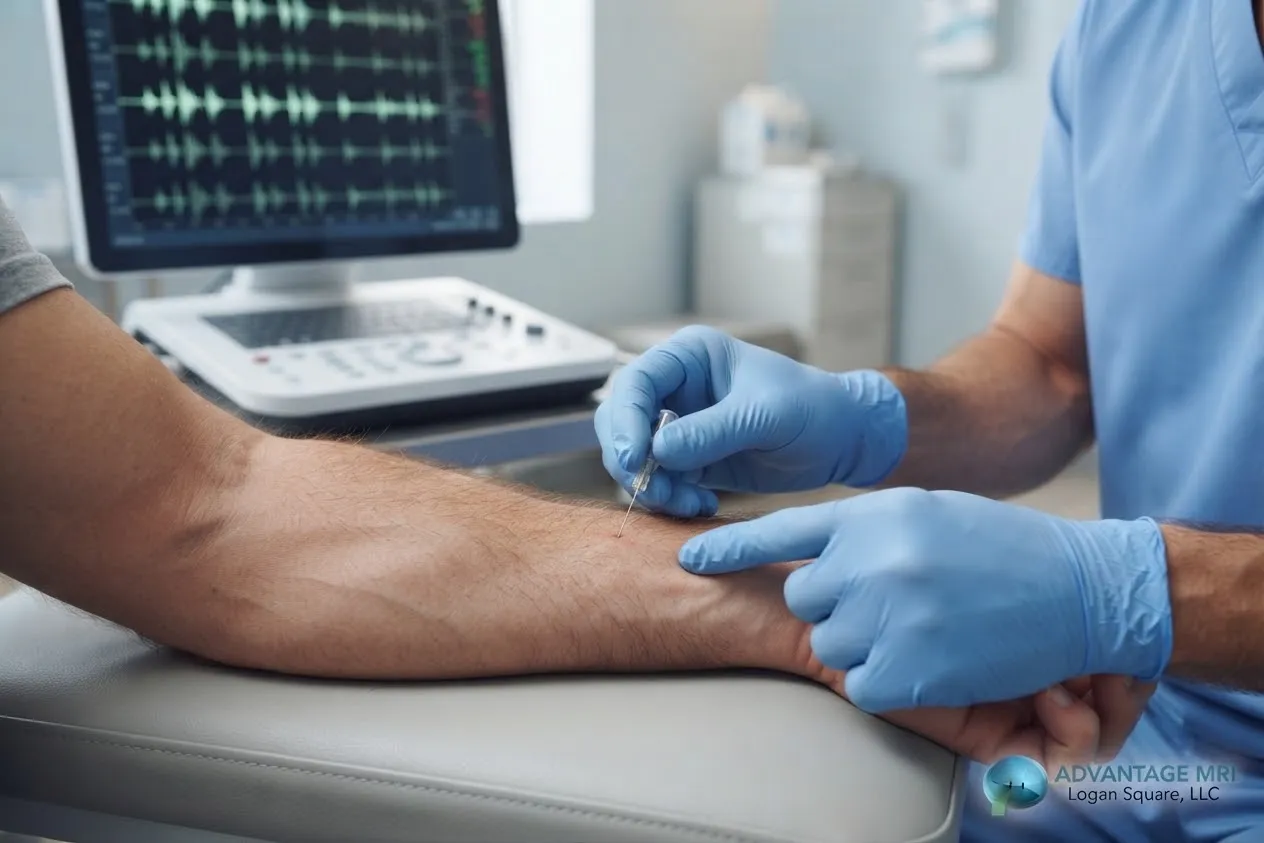
EMG stands for electromyography. It’s a diagnostic test that measures the electrical activity in your muscles when they contract and when they’re at rest. A small needle electrode is placed into the muscle and it picks up electrical signals that get displayed on a monitor or printed out for review.
Doctors use EMG testing to figure out whether muscle weakness numbness or pain is coming from a problem with the muscle itself or from the nerve that controls it. That distinction matters a lot for treatment. A pinched nerve gets treated differently than a muscle disorder even though both can cause similar symptoms.
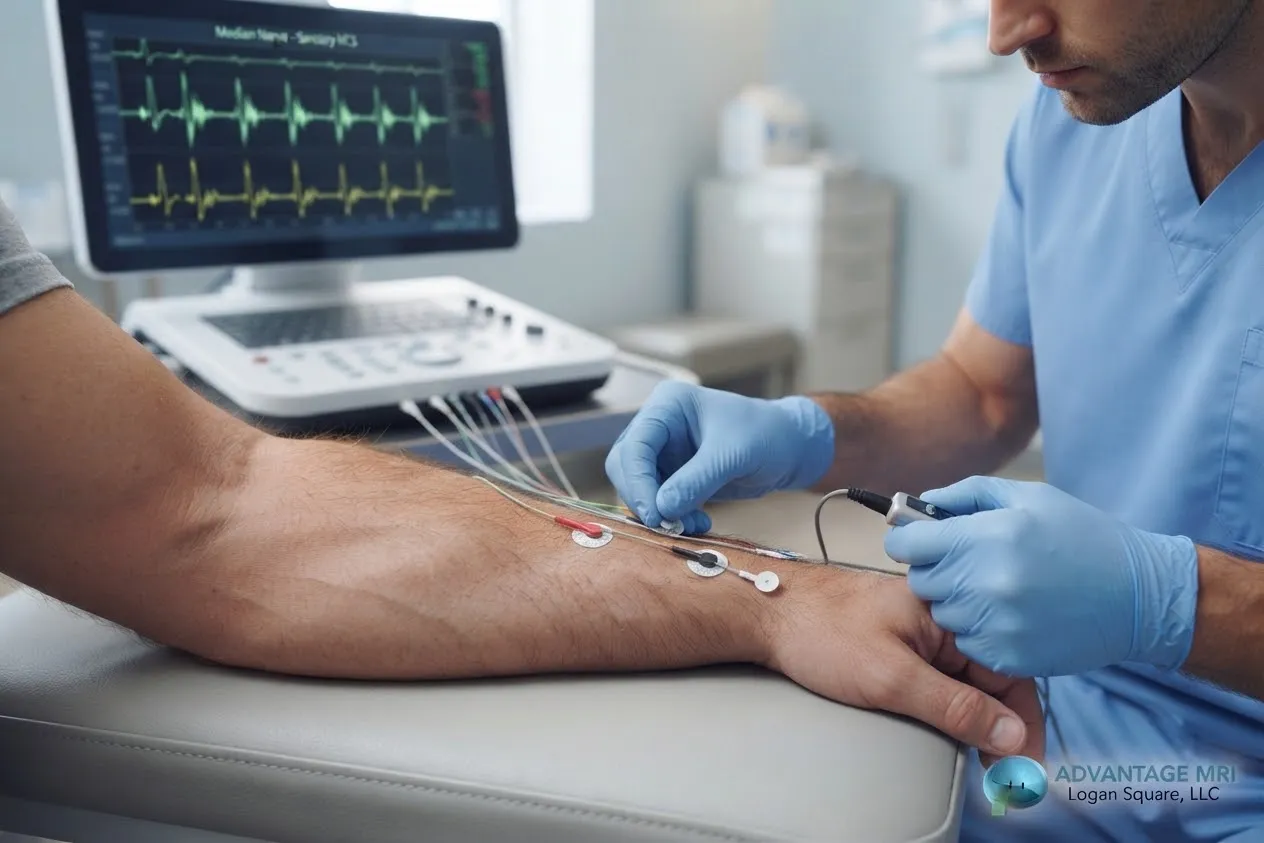
EMG is often paired with a nerve conduction study or NCS. The two tests are related but they measure different things. EMG looks at muscle and nerve electrical activity through a needle electrode. Nerve conduction study measures how fast electrical signals travel along a nerve using small electrode pads placed on the skin.
| Test | What It Measures | How It’s Done | Typical Time |
|---|---|---|---|
| EMG (needle test) | Electrical activity in muscle fibers | Thin needle electrode inserted into muscle | 20 to 45 minutes |
| Nerve Conduction Study | Speed of nerve signals | Electrode pads placed on skin with a mild electrical pulse | 15 to 30 minutes |
| EMG and NCS combined | Muscle and nerve function together | Both methods used in one visit | 45 to 90 minutes |
You can read more about the difference between these two tests on our nerve conduction study vs EMG page if you want a deeper comparison.
How Long Does an EMG Test Take Step By Step
So how long does it take to do an EMG test once you’re actually in the room. Here’s how a typical visit breaks down.
Check in and setup. This usually takes 10 to 15 minutes. You’ll fill out a short health history form and the technologist or physician will explain what to expect. If you’re testing an arm or leg they may ask you to remove clothing or jewelry near that area.
Skin prep and electrode placement. A few minutes are spent cleaning the skin where electrodes will go. This step is quick and mostly just prep work before the actual test begins.
Needle EMG testing. This is the part most people are curious about. A thin needle electrode is inserted into the muscle being tested and you may be asked to relax the muscle and then gently contract it. The provider is watching for the electrical pattern on the screen. Each muscle tested takes just a few minutes but if several muscles need to be tested it adds up. Testing two or three muscles usually takes 20 to 30 minutes total.
Nerve conduction portion if included. If your doctor ordered nerve conduction studies too a mild electrical pulse is sent through the nerve using surface electrodes. This part typically adds another 15 to 30 minutes depending on how many nerves are tested.
Wrap up. Electrodes come off cleanup takes a minute or two and the provider may go over what happens next.
Put it all together and a straightforward EMG test on one or two muscles can be done in under 30 minutes. A more involved test that covers multiple muscles and includes nerve conduction studies on several nerves can take closer to 90 minutes. There isn’t one single answer to how long an EMG test takes because it depends entirely on what’s being evaluated.
Why Some EMG Tests Take Longer Than Others
A few things affect how long you’ll actually be in the room.
Number of muscles tested. If your doctor only needs to check one muscle in your hand for something like carpal tunnel syndrome the test moves fast. If the concern is broader such as suspected muscular dystrophy or amyotrophic lateral sclerosis the provider may need to test several muscles across different parts of the body which naturally takes longer.
The condition being investigated. Some conditions need a more thorough workup. A pinched nerve in the lower back for example might require testing several nerve roots to find exactly where the compression is happening. You can see more on this in our post about EMG testing on the lower back.
Whether nerve conduction studies are included. As mentioned earlier adding NCS to the visit extends the appointment. Most neurologists order both together because EMG and nerve conduction studies used together give a clearer picture of nerve and muscle function than either test alone.
Patient factors. Things like difficulty relaxing a muscle nervousness or anatomical differences can add a few extra minutes here and there. It’s nothing to worry about. The provider will work at a pace that keeps things as comfortable as possible.
Single fiber EMG. This is a more specialized version of the test used for conditions like myasthenia gravis. Single fiber EMG takes longer than a standard EMG because it measures activity from individual muscle fibers rather than a whole muscle group. This type of testing isn’t common and is usually reserved for specific diagnostic questions from a neurologist.
Do EMG Tests Hurt and Does That Affect the Time
A common question is whether EMG tests hurt enough to slow things down. The needle electrode can cause a brief pinch or tingle when it’s inserted and some people feel mild soreness in the muscle during or after testing. Most people describe it as uncomfortable rather than painful and the sensation doesn’t usually last.
If a muscle is especially tender or if nerve damage is already causing pain in that area the provider may need to pause or adjust which can add a small amount of time. This is normal and the goal is always to keep you as comfortable as possible while still getting accurate results.
Bruising at the needle site is possible but usually minor. If you take blood thinners let your provider know beforehand since that can increase the chance of a small bruise. It doesn’t usually change how the test is performed but it’s good information for your care team to have.
What Happens After the Test
Once the test wraps up there isn’t much required of you. You can typically drive yourself home and return to normal activities right away. Some people notice mild soreness in the tested muscle for a day or two which usually resolves on its own.
Results of the test aren’t usually available immediately. The provider reviewing your EMG needs time to interpret the electrical patterns and put together a report. In most cases results are typically available within a few days and your referring doctor will discuss the results with you at a follow up visit.
If you have questions you may have regarding a medical condition found during testing your neurologist or referring physician is the right person to walk you through next steps and treatment options.
EMG Testing at Advantage MRI in Chicago
At Advantage MRI in the Hermosa neighborhood we perform EMG and nerve conduction studies as part of our diagnostic imaging services. Our team works to keep appointments efficient without rushing through the parts that matter for accurate results.
Testing is overseen with input from board certified specialists including Dr. Gregory T. Goldstein MD a board certified diagnostic radiologist with a background in orthopedic and neurological imaging. That kind of oversight matters when the goal is a test that’s read correctly the first time.
If your doctor has referred you for an EMG test or if you’re looking into EMG testing as part of figuring out nerve or muscle related symptoms our team can walk you through what to expect for your specific situation. We also offer nerve conduction studies for patients who need both tests done together.
You can learn more about our practice and approach to diagnostic testing on our about us page.
Frequently Asked Questions
How long does an EMG test take total?
Most EMG tests take between 30 and 60 minutes from start to finish. If nerve conduction studies are added the full appointment can run 60 to 90 minutes depending on how many muscles and nerves are being checked.
How long does it take to do an EMG test with nerve conduction studies combined?
When EMG and nerve conduction studies are done together in one visit the combined appointment usually takes 45 to 90 minutes. The exact time depends on how many nerves and muscles your doctor wants evaluated.
Does an EMG test take longer for hands versus legs?
Not necessarily. The time depends more on how many muscles or nerve segments are being tested rather than which body part is involved. A hand test for carpal tunnel syndrome and a leg test for sciatica can both take a similar amount of time if a similar number of sites are checked.
How long do EMG tests take if multiple muscles are checked?
Testing multiple muscles adds time since each muscle needs its own needle insertion and electrical reading. A test covering three or four muscles can take 30 to 45 minutes just for the EMG portion.
How long is an EMG test appointment from check in to check out?
Counting check in paperwork skin prep the actual test and wrap up most patients are in and out within an hour. More complex cases involving several muscles and nerve conduction studies can take closer to 90 minutes.
Does the length of an EMG test change based on the condition being tested?
Yes. A focused test for something like carpal tunnel syndrome tends to be quicker because fewer muscles need checking. Conditions like muscular dystrophy neuropathy or suspected nerve root problems often require testing more sites which extends the visit.
How soon after an EMG test can you drive or return to normal activity?
Most people can drive themselves home and return to regular activities right after the test. There’s no sedation involved so there’s no recovery time needed before getting back to your day.
How long until you get EMG test results?
Results are typically available within a few days after testing. Your referring doctor will go over what the test showed and explain what it means for your specific situation.
Why did my EMG appointment take longer than expected?
A longer appointment usually means more muscles or nerves needed testing than originally planned or the provider found something that needed a closer look. This isn’t unusual and it doesn’t mean anything went wrong.
Is EMG test time different for carpal tunnel testing specifically?
Carpal tunnel testing is often on the shorter end since it usually focuses on nerves and muscles in the hand and wrist. Many carpal tunnel evaluations combine a quick EMG with nerve conduction studies and still finish within 45 minutes to an hour.
Conclusion
So how long does an EMG test take. In most cases you’re looking at 30 to 60 minutes for the EMG portion alone and up to 90 minutes if nerve conduction studies are included. The exact time depends on your symptoms how many muscles and nerves need checking and the condition your doctor is trying to rule in or out.
Knowing what to expect can make the whole thing feel a lot less intimidating. If you have an EMG test coming up talk to your doctor about what’s being tested so you have a realistic idea of how long your appointment will run.
Contact Us
- Address: 2008 N Pulaski Rd, Chicago, IL 60639
- Phone: (773) 227-9777
- For general inquiries visit our Contact Us page
For reliable advanced diagnostic imaging you can trust call Advantage MRI today or schedule your appointment online.
Follow us on social media for the latest health tips diagnostic imaging updates and clinic news: Facebook | Instagram | LinkedIn.