Health & Imaging
MRI vs CT Scan: Differences, Costs, Safety and When Each Is Used
Quick answer: The main difference between an MRI and a CT scan is how they create images. A CT (computed tomography) scan uses X-rays and is fast, usually taking seconds to a few minutes, which makes it ideal for emergencies, bone injuries, bleeding, and chest and abdominal problems. An MRI (magnetic resonance imaging) uses a strong magnet and radio waves instead of radiation and shows soft tissues, such as the brain, spinal cord, nerves, muscles, ligaments and cartilage, in much greater detail, but it takes longer (often 20 to 60 minutes) and usually costs more. Doctors choose between them based on the body part, the question they need answered, how urgent it is, and your safety factors.
This pillar guide on mri vs ct scan covers everything patients usually want to know: how each scan works, what each shows best, safety and radiation, contrast, scan time, cost, and how doctors decide.
MRI vs CT: Side-by-Side Comparison
| MRI | CT scan | |
|---|---|---|
| Full name | Magnetic resonance imaging | Computed tomography |
| How it works | Strong magnetic field and radio waves | X-rays and computer processing |
| Ionizing radiation | No | Yes |
| Typical scan time | 20-60 minutes | Seconds to a few minutes |
| Best at | Soft tissue: brain, spinal cord, nerves, joints, ligaments, tendons, cartilage, many organs | Bone, lungs, bleeding, trauma, chest and abdominal emergencies |
| Noise | Loud knocking and buzzing | Quiet, with mild whirring |
| Space | Longer tunnel (wide-bore and open designs exist) | Short, open ring |
| Metal and implants | Must be screened carefully; some devices unsafe | Rarely a safety issue |
| Contrast | Gadolinium-based (when needed) | Iodine-based (when needed) |
| Typical cost | Usually higher | Usually lower |
| Availability | Widely available; scheduling may take longer | Very widely available, including 24/7 emergency use |
How Does a CT Scan Work?
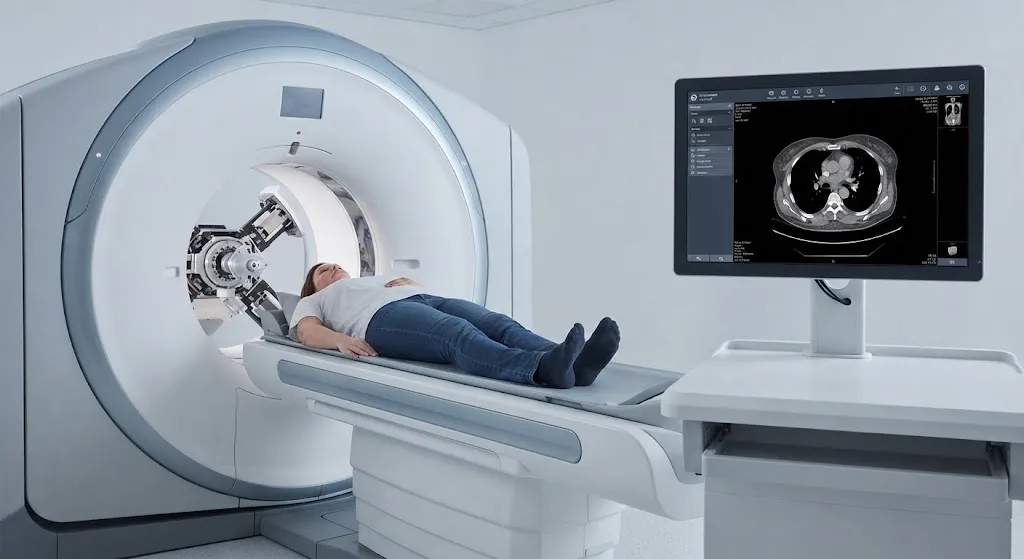
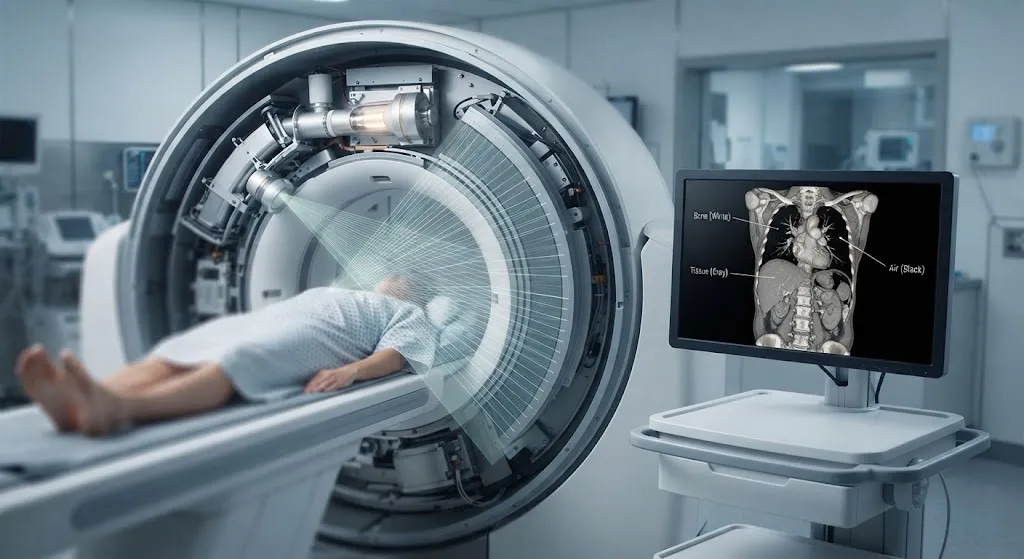
A CT scanner is a large ring that an X-ray tube rotates around while you lie on a moving table. As the tube spins, detectors measure how much X-ray energy passes through your body from hundreds of angles. A computer combines this information into thin cross-sectional images, which can also be stacked into 3D views.
Need to Schedule a Diagnostic Appointment?
Whether you need an MRI, ultrasound, X-ray, or another diagnostic service, Advantage MRI is here to help you take the next step in your healthcare journey.
Submit your appointment request online, and our team will contact you to confirm your visit.
Book Your Appointment →Different tissues absorb X-rays differently. Bone absorbs a lot and appears bright white. Air appears black. Soft tissues fall in between in shades of gray. CT is particularly good at showing:
- Fractures and complex bone injuries
- Bleeding inside the head, chest or abdomen
- The lungs, including nodules, pneumonia and blood clots in the lung arteries (with contrast)
- Kidney stones
- Appendicitis and many other abdominal emergencies
- Blood vessels, using CT angiography
How Does an MRI Work?
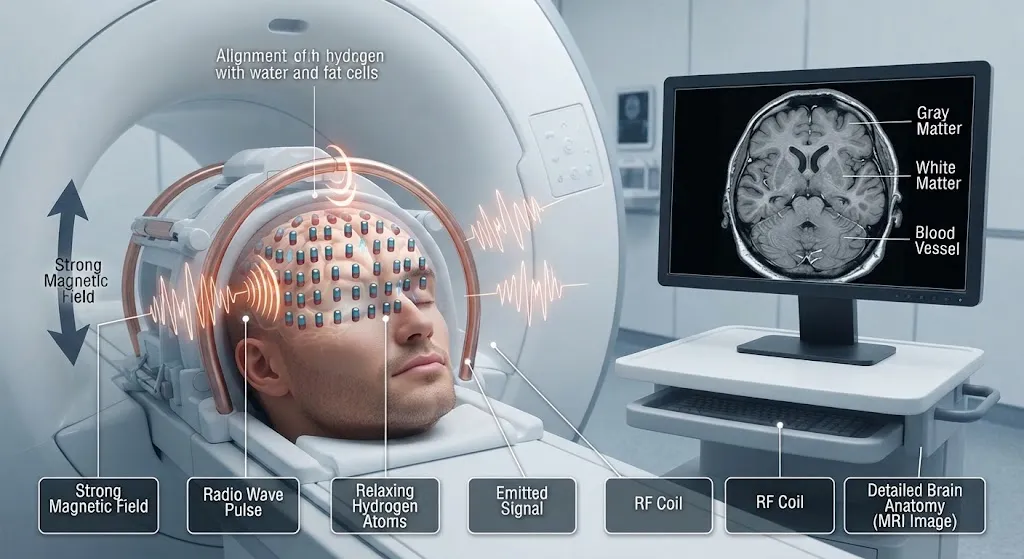
An MRI scanner contains a powerful magnet. When you’re inside it, the hydrogen atoms in your body’s water and fat line up with the magnetic field. Short radio wave pulses briefly knock them out of alignment. As they relax back, they give off signals that the scanner detects. Because different tissues relax at different rates, MRI can produce striking contrast between soft tissues.
MRI scans are made of several “sequences,” each designed to highlight particular features, such as fluid, fat, inflammation, blood flow or how water molecules move. That flexibility is why MRI is so useful for:
- The brain and spinal cord
- Nerve compression and disc problems in the spine
- Ligaments, tendons, menisci and cartilage in joints
- Muscles and soft-tissue masses
- Many liver, pelvic and prostate conditions
- Bone marrow problems and stress fractures that X-rays can miss
The loud sounds come from rapidly switching magnetic coils. Our article on why MRI scans are so loud explains the noise and how to cope with it.
What Is the Difference Between MRI and CT? The 7 Key Differences
1. Image Detail: Soft Tissue vs Bone
MRI shows soft-tissue differences far better than CT. A torn ligament, a small disc herniation pressing on a nerve, or an early multiple sclerosis lesion may be invisible on CT but clear on MRI. CT, on the other hand, gives excellent bone detail and is often preferred for complex fractures and the lungs.
2. Radiation
CT uses ionizing radiation; MRI does not. A single CT scan carries a small risk that is generally outweighed by the benefit of a needed diagnosis. Radiation becomes a bigger consideration for children, pregnant patients and people who need many scans over time. MRI is often chosen for repeated follow-up imaging partly for this reason.
3. Speed
CT is much faster. A CT of the head or chest can take seconds. That speed is critical in emergencies and for patients who can’t hold still. MRI exams usually last 20 to 60 minutes, and moving during the scan blurs the images.
4. Comfort and Experience
CT is quiet and the ring is short, so most people don’t feel enclosed. MRI is louder, the tunnel is longer, and you must stay still for longer. People with claustrophobia may find MRI harder. Earplugs, music, eye covers, talking with the technologist, and, when prescribed by a doctor, mild sedation can help. Wide-bore and open MRI designs are available at some facilities.
5. Safety With Metal and Implants
MRI’s strong magnet means safety screening is essential. Some implants are unsafe in MRI, while many modern devices are “MR conditional” and can be scanned under specific settings. CT has very few metal-related safety concerns, although metal can cause image streaks.
6. Contrast Agents
Both tests sometimes use contrast to highlight blood vessels or abnormal tissue:
- CT contrast contains iodine and is given by IV or by mouth.
- MRI contrast contains gadolinium and is given by IV.
People with significant kidney disease, previous contrast reactions or pregnancy need special consideration for either type. Many scans don’t need contrast at all.
7. Cost
MRI usually costs more than CT for the same body region because the equipment is more expensive and the exam takes longer. Prices vary widely by location, facility type and insurance.
MRI or CT Scan? Which Is Better for Each Body Part
| Body area or problem | Usually preferred first | Why |
|---|---|---|
| Head injury or suspected brain bleed | CT | Fast; shows bleeding and fractures |
| Brain tumors, MS, seizures, small strokes | MRI | Superior soft-tissue detail |
| Neck or back pain with nerve symptoms | MRI | Shows discs, nerves and spinal cord |
| Spine fractures after trauma | CT | Fast; detailed bone |
| Knee, shoulder, hip, ankle soft-tissue injuries | MRI | Shows ligaments, tendons, cartilage, menisci |
| Complex fractures | CT | 3D bone detail |
| Lungs (nodules, pneumonia, clots) | CT | Air and lung tissue visualized well |
| Abdominal pain in the emergency room | CT | Fast; good for appendicitis, bowel problems |
| Kidney stones | CT | Very sensitive for stones |
| Liver lesions (characterization) | Often MRI | Better tissue characterization |
| Pelvis and prostate | Often MRI | Soft-tissue detail |
| Soft-tissue masses | MRI | Shows extent and makeup |
| Stress fractures and bone bruises | MRI | Detects marrow changes early |
These are general patterns. For brain-specific decisions, read our detailed guide on which is better for the brain, MRI or CT.
When Is CT the Better Choice?
- Emergencies and trauma. Speed and 24/7 availability make CT the standard in emergency departments.
- Suspected bleeding. CT shows fresh blood in the brain and body quickly.
- Lung problems. CT is the go-to test for lung nodules and many chest conditions.
- Kidney stones and many abdominal emergencies.
- Patients who can’t have MRI. For example, those with certain implants or who can’t lie still for long.
- Detailed bone imaging. Especially complex fractures and surgical planning.
When Is MRI the Better Choice?
- Brain and spinal cord conditions.
- Spine problems with nerve symptoms, such as sciatica, numbness or weakness.
- Joint and sports injuries, including torn ACLs, meniscus tears and rotator cuff tears.
- Soft-tissue masses and many tumors.
- When radiation should be avoided or minimized, such as in younger patients or for repeated follow-up.
- Detailed evaluation after an X-ray or CT didn’t explain symptoms.
Many joint and back problems start with a plain X-ray before MRI. Our MRI vs X-ray guide explains why.
Where Does a PET Scan Fit In?
A PET scan is different from both. It uses a small amount of radioactive tracer to show how tissues are functioning, and it’s usually combined with CT (PET/CT). It’s commonly used in cancer staging, some brain disorders and certain heart evaluations. See our plain-English guide to PET vs CT vs MRI.
Safety: Is MRI or CT Safer?
Both are safe for most people when medically appropriate. The risks are different.
CT Safety
- Radiation: small risk per scan, cumulative over time. Tell your doctor if you’ve had many CTs.
- Iodine contrast: possible allergic-type reactions, usually mild; potential kidney effects in people with significant kidney disease.
- Pregnancy: CT of the abdomen and pelvis is avoided when possible. CT of other areas may still be done when needed, with protective measures.
MRI Safety
- No ionizing radiation.
- Magnetic field hazards: metal objects can be pulled toward the magnet, and some implants can malfunction or heat up. Thorough screening prevents these problems.
- Gadolinium contrast: serious reactions are uncommon. People with severe kidney disease require special consideration, and small amounts of gadolinium can remain in the body. Doctors use contrast only when it adds value.
- Noise: hearing protection is always provided.
- Pregnancy: MRI without contrast is generally preferred when imaging is needed during pregnancy.
Tell the Team If You Have:
- A pacemaker or implanted defibrillator
- Cochlear implants or other ear implants
- Aneurysm clips, stents or heart valves
- Neurostimulators, insulin pumps or drug pumps
- Metal fragments, especially near the eyes (common in metalworkers or after injuries)
- Joint replacements, plates, screws or rods
- Tattoos or permanent makeup (rarely cause warmth or irritation)
- Pregnancy, possible pregnancy or breastfeeding
- Kidney disease or prior contrast reactions
How to Prepare for an MRI vs a CT Scan
MRI Preparation
- Complete the safety screening form honestly and in full.
- Remove jewelry, watches, hair accessories, hearing aids, removable dental work and anything metallic.
- Wear metal-free clothing or change into a gown.
- Fasting depends on the body part and whether contrast is used. See can you eat before an MRI?
- Mention claustrophobia in advance so your doctor can plan.
CT Preparation
- Remove metal from the area being scanned.
- If you’ll receive contrast, you may need to fast for a few hours and have kidney function checked.
- For some abdominal CTs, you may drink oral contrast beforehand.
- Tell staff about diabetes medications, allergies and pregnancy.
What Does Each Scan Feel Like?
During a CT: You lie on a table that slides through the ring. You may be asked to hold your breath briefly. If IV contrast is used, you might feel a warm flush or a metallic taste for a few seconds. The scan is over very quickly.
During an MRI: You lie on a padded table, and a coil may be placed around the body part being scanned. The table moves into the scanner. You’ll hear loud tapping, knocking and buzzing in bursts. You can talk to the technologist through an intercom and will usually have a call button. You might feel slightly warm. Staying still is the most important thing you can do.
MRI vs CT Cost
Exact prices vary widely, but these patterns hold in most places:
- MRI generally costs more than CT for the same body area.
- Contrast adds cost to either test.
- Hospital-based imaging is often more expensive than imaging at an independent outpatient center.
- Insurance frequently requires prior authorization for MRI, and sometimes for CT.
- Self-pay prices are often lower than the “list price” billed to insurance. Ask for a written self-pay quote.
Questions to ask before scheduling:
- Is this facility in-network for my plan?
- Is prior authorization required, and has it been approved?
- Is the radiologist’s interpretation included in the price, or billed separately?
- Is contrast included?
How Do Doctors Decide Between MRI and CT?
Doctors consider:
- The clinical question. What exactly are they trying to find or rule out?
- Urgency. Emergencies usually favor CT.
- The body area. Soft tissue favors MRI; bone, lungs and acute bleeding often favor CT.
- Your safety profile. Implants, kidney function, pregnancy, allergies and radiation history.
- Your ability to tolerate the scan. Claustrophobia, pain or difficulty lying still.
- Guidelines. Many clinicians use the American College of Radiology Appropriateness Criteria, which rate how useful each imaging test is for specific clinical situations.
- Insurance rules. Some plans require a cheaper test, such as an X-ray, first.
You can always ask your doctor why they chose a particular scan and what the alternative would show. If you’re wondering about scanning without symptoms, our article on full-body MRI scans explains the evidence and limitations.
MRI at Advantage MRI in Chicago
Advantage MRI is an outpatient diagnostic imaging center at 2008 N Pulaski Rd, Chicago, IL 60639, serving Hermosa, Logan Square, Humboldt Park and surrounding communities. We provide MRI imaging, digital X-ray, ultrasound and Doppler, echocardiograms, EKGs, Holter monitoring, EMG and nerve conduction studies. You can see our full list of diagnostic services.
We do not perform CT scans. If your doctor orders a CT, it’s typically done at a hospital or another imaging facility. If MRI is the right test, our team handles safety screening, scheduling and reporting to your referring physician. Our website states that studies are interpreted by sub-specialized, board-certified radiologists and that the center is ACR accredited. Learn more on our About page. We welcome insured, out-of-network and self-pay patients.
Frequently Asked Questions About MRi VS CT Scan
What is the main difference between an MRI and a CT scan?
CT uses X-rays and is fast, making it ideal for emergencies, bone and lungs. MRI uses magnets and radio waves, has no ionizing radiation, and shows soft tissues like the brain, nerves and ligaments in more detail, but takes longer.
Which is more accurate, MRI or CT?
Neither is more accurate overall. Each is more accurate for different problems. MRI is usually better for soft tissue; CT is usually better for bone, lungs and acute bleeding.
Why would a doctor order an MRI instead of a CT scan?
To get detailed images of soft tissue, such as the brain, spinal cord, joints, ligaments or certain organs, or to avoid radiation when possible.
Why would a doctor order a CT instead of an MRI?
For speed in emergencies, for bone and lung detail, for suspected bleeding, or when a patient can’t safely have MRI.
Is an MRI safer than a CT scan?
MRI avoids ionizing radiation, but it isn’t safe for certain implants and metal objects. Both are safe for most people when they’re medically appropriate.
Why does an MRI take so much longer than a CT?
MRI collects several sequences, each taking minutes, to show different tissue properties. CT collects all its data in one quick rotation sequence.
Can you have an MRI with metal in your body?
Often yes. Many joint replacements, plates and screws are safe, and many devices are MR conditional. The imaging team needs exact details about every implant before scanning.
Is MRI or CT better for back pain?
For back pain with leg pain, numbness or weakness, MRI is usually preferred because it shows discs and nerves. CT is mainly used after trauma or when MRI isn’t possible. Many cases of back pain don’t need imaging at all in the first weeks.
Is a CT scan or MRI more expensive?
MRI usually costs more than CT for the same body area. Actual costs depend on the facility, contrast use and insurance.
Conclusion
MRI and CT are complementary tools. CT is fast and excellent for emergencies, bones, lungs and bleeding. MRI is radiation-free and unmatched for soft tissue, making it the top choice for the brain, spine, nerves and joints. The right scan depends on your symptoms, the body area and your safety factors, and your doctor will match the test to the question. Knowing the differences helps you ask better questions and feel prepared on scan day.
Has your doctor ordered an MRI? Book your MRI at Advantage MRI or call (773) 227-9777. Open Monday-Friday 9:00 AM-5:00 PM and Saturday 9:00 AM-1:00 PM. Questions first? Contact us. Follow us on Facebook and Instagram.