Health & Imaging
Holter Monitoring for Palpitations, PVCs and Arrhythmia: What It Catches

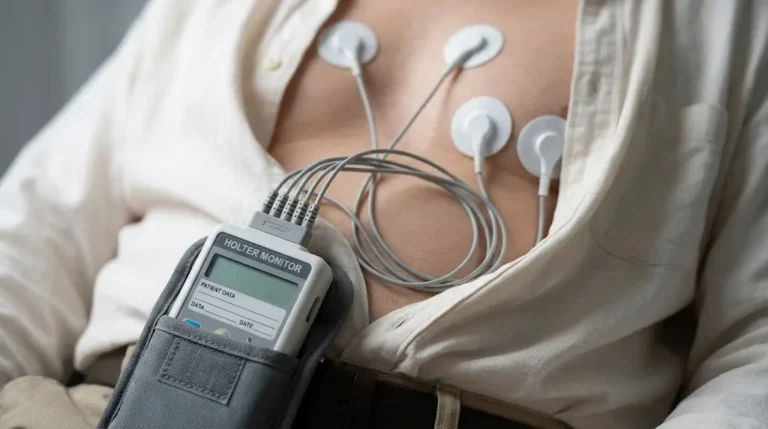
Quick answer: Using a holter monitor for palpitations is one of the most effective ways to find answers about an irregular heartbeat. It is a small, portable EKG recorder you wear for 24 to 48 hours (and sometimes up to 14 days) while going about your normal routine. It records every heartbeat, which makes it one of the most useful tests for explaining palpitations, the feeling of a skipped, pounding, fluttering or racing heart. A Holter can detect and count premature beats (PVCs and PACs), and it can capture atrial fibrillation, supraventricular tachycardia (SVT), runs of ventricular beats, slow rhythms and pauses. By matching your symptom diary to the recording, doctors can see whether your palpitations come from a harmless rhythm or something that needs treatment. A Holter can’t reliably detect blocked arteries. That requires other tests.
If palpitations come with chest pain, fainting, severe shortness of breath or confusion, call 911.
What Are Heart Palpitations?
Palpitations are an awareness of your heartbeat. People describe them as:
Need to Schedule a Diagnostic Appointment?
Whether you need an MRI, ultrasound, X-ray, or another diagnostic service, Advantage MRI is here to help you take the next step in your healthcare journey.
Submit your appointment request online, and our team will contact you to confirm your visit.
Book Your Appointment →- A skipped or “missed” beat
- A flip-flop or thud in the chest
- Fluttering
- Pounding, especially when lying down
- A racing heart that starts and stops suddenly
- An irregular, chaotic beat
Palpitations are very common, and most are harmless. Common triggers include caffeine, alcohol, nicotine, stress, poor sleep, dehydration, fever, pregnancy, thyroid problems, anemia and certain medications or decongestants. Sometimes, though, palpitations come from an arrhythmia that needs attention. A Holter monitor helps tell the difference.
Why a Standard EKG Often Isn’t Enough
A resting EKG records only about 10 seconds. If your palpitations happen a few times a day or come and go unpredictably, a 10-second snapshot will usually miss them. A Holter monitor records continuously, so it can catch the rhythm at the exact moment you feel symptoms. Learn more about the standard test in What Is an EKG Test?
What Can a Holter Monitor Detect?
Premature Ventricular Contractions (PVCs)
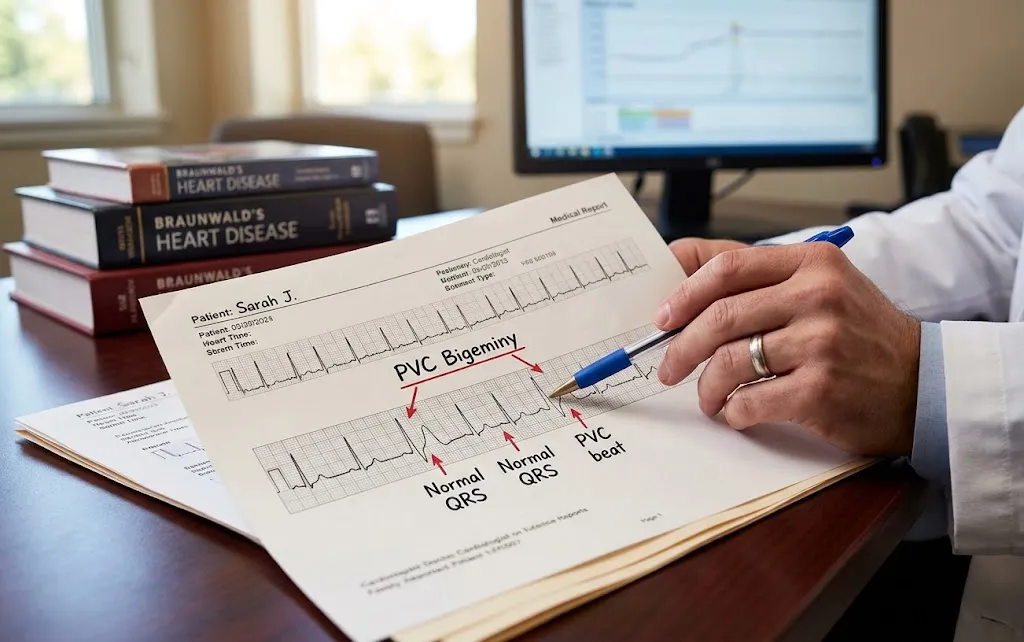
PVCs are extra beats that start in the lower chambers (ventricles). They’re among the most common causes of palpitations, often felt as a skip followed by a stronger beat. Holter monitoring is especially valuable for PVCs because it:
- Counts them over the whole recording
- Calculates PVC burden, the percentage of all heartbeats that are PVCs
- Shows whether they occur singly, in pairs (couplets), in patterns (bigeminy, trigeminy) or in runs
- Shows whether there’s more than one shape, which can suggest more than one source
- Shows when they happen, such as during rest, exercise or sleep
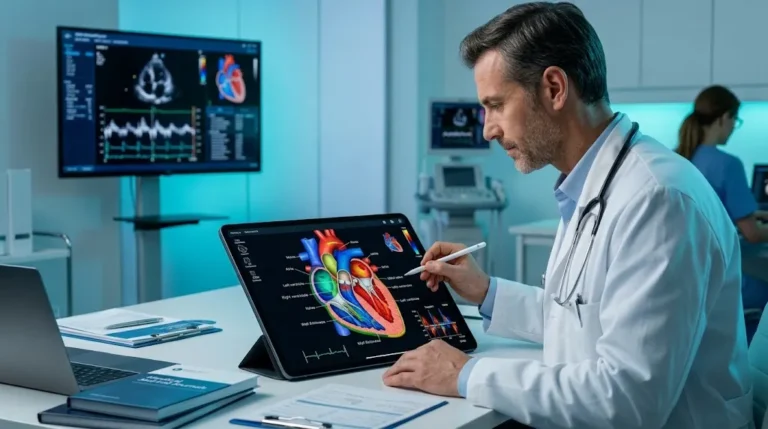
Why burden matters: occasional PVCs are common in healthy hearts. A very high PVC burden, often cited as above roughly 10 percent of beats, may be linked in some people to weakening of the heart muscle over time. When the burden is high, doctors commonly order an echocardiogram to check heart function. Exact thresholds and management depend on the person, so your doctor will interpret the number in context.
What Causes PVCs?
PVCs often have no single identifiable cause and occur in people with structurally normal hearts. Factors that can increase them include caffeine, alcohol, nicotine, stimulants, stress, sleep deprivation, low potassium or magnesium, thyroid overactivity and certain medications. In some people, PVCs are linked to underlying heart conditions, such as cardiomyopathy, prior heart attack or valve disease, which is why an echocardiogram is often part of the evaluation. Many people notice PVCs more at rest or when lying on their left side, simply because they’re paying closer attention to their heartbeat. Feeling them more doesn’t necessarily mean there are more of them. A Holter gives an objective count, which often helps both patient and doctor understand what’s really happening.
Premature Atrial Contractions (PACs)
PACs are extra beats from the upper chambers. They’re usually benign but can sometimes precede atrial fibrillation. A Holter counts them and looks for short runs.
Atrial Fibrillation and Atrial Flutter
AFib causes an irregular, often fast heartbeat. It may come and go (paroxysmal AFib). Capturing it matters because AFib increases stroke risk. A Holter can show when episodes start, how long they last, and how fast the heart rate goes.
Supraventricular Tachycardia (SVT)
SVT causes sudden episodes of a fast, regular heartbeat that start and stop abruptly. If episodes happen during the recording, the Holter shows them clearly.
Ventricular Tachycardia (VT)
Runs of fast beats from the ventricles can be significant, especially in people with structural heart disease. A Holter can capture short runs, sometimes called nonsustained VT.
Slow Heart Rhythms, Pauses and Heart Block
A Holter can catch:
- Sinus bradycardia (slow heart rate), including during sleep
- Sinus pauses
- Intermittent heart block
These are especially relevant if your symptoms include dizziness, lightheadedness or fainting rather than racing.
Heart Rate Patterns
The report shows your minimum, maximum and average heart rates and how they change with activity and sleep. It can also help evaluate the effect of medications on heart rate.
Holter Monitor for Arrhythmia: Matching Symptoms to Rhythm
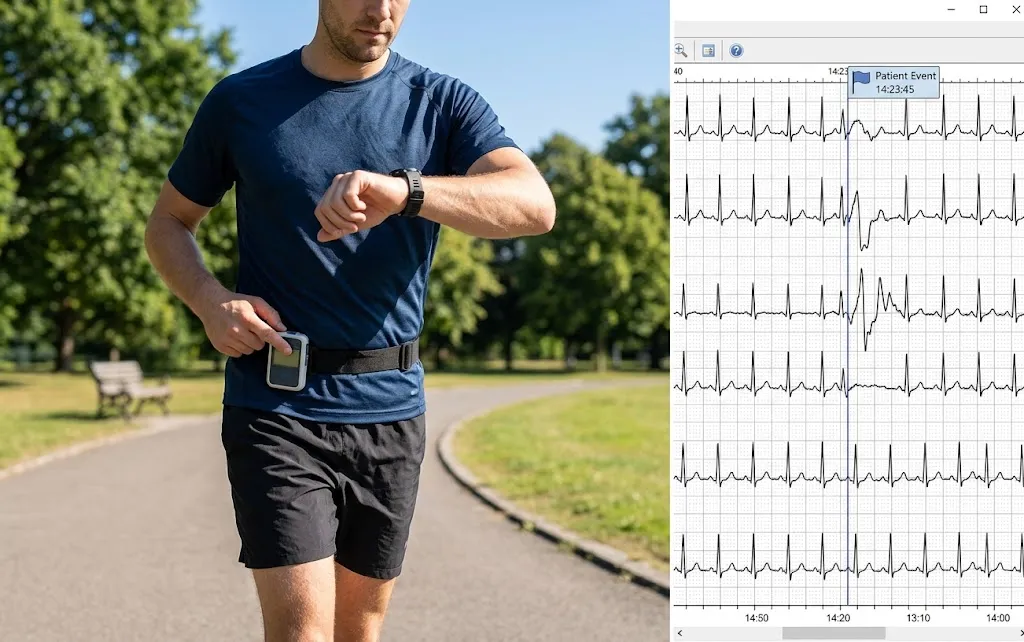
The most important part of a Holter study for palpitations is symptom correlation: lining up exactly what you felt with what your heart was doing at that moment. There are four common outcomes:
| What you felt | What the Holter showed | What it often means |
|---|---|---|
| Palpitations | PVCs or PACs at the same time | Symptoms explained by premature beats |
| Palpitations | An arrhythmia, such as AFib or SVT | Symptoms explained by an arrhythmia that may need treatment |
| Palpitations | Normal sinus rhythm | Symptoms likely not due to an arrhythmia, which is also useful information |
| No symptoms | An arrhythmia anyway | A “silent” rhythm that may still need attention |
That’s why your symptom diary or event button matters so much.
How to Keep a Useful Symptom Diary
Most Holter monitors come with a paper diary, a smartphone app or a button to mark symptoms. For each episode, note:
- Time (as exact as possible)
- What you felt: skipped beat, flutter, racing, pounding, dizziness, chest discomfort, shortness of breath
- How long it lasted
- What you were doing: resting, climbing stairs, after a meal, lying in bed, after coffee
- Any triggers you noticed
Also note daily activities like exercise, sleep times and medication doses. A well-kept diary turns a recording into a clear answer.
When Palpitations Need Urgent Care
Most palpitations aren’t dangerous, but some situations need immediate attention. Call 911 or go to the nearest emergency department if palpitations come with:
- Chest pain, pressure or tightness
- Fainting or nearly fainting
- Severe shortness of breath
- A very fast heartbeat that doesn’t settle with rest
- Confusion, weakness on one side, or trouble speaking
Seek prompt (same-day or next-day) medical advice if palpitations are new and frequent, if you have known heart disease, or if there’s a family history of sudden cardiac death at a young age.
Palpitations in Specific Situations
Pregnancy
Blood volume and heart rate rise during pregnancy, and extra beats are common. Most are harmless, but new palpitations should still be mentioned to your obstetric provider. Holter monitoring is safe during pregnancy because it only records signals.
Athletes
Trained athletes often have slow resting heart rates and occasional extra beats. Palpitations during exercise, or with dizziness or fainting during exertion, should be evaluated before continuing intense training.
Perimenopause and Menopause
Hormonal changes can bring palpitations, sometimes along with hot flashes and sleep disruption. These are often benign, but other causes, such as thyroid problems or arrhythmias, still need to be ruled out.
Older Adults
Atrial fibrillation becomes more common with age. Because AFib raises stroke risk, older adults with new irregular palpitations are often monitored to look for it.
Holter Monitor vs Smartwatch Alerts
Many people first notice a problem when a smartwatch flags an irregular rhythm. A single-lead recording from a watch can be useful, especially if you capture it during symptoms, and you should share it with your doctor. But watches typically record only when you trigger them or at intervals, and they don’t provide the continuous, multi-lead recording, beat counting and physician-reviewed report that a Holter provides. A watch alert is often the reason a Holter is ordered, not a replacement for one.
Preparing for Your Holter Appointment
- Shower before your appointment, since showering is usually restricted while wearing a traditional Holter.
- Wear a loose, button-front or two-piece top that fits over the wires and recorder.
- Skip lotion and oils on your chest so the electrodes stick.
- Men may need small areas of chest hair shaved; the technician can do this.
- Bring a list of medications and, if you have one, any smartwatch recordings of your symptoms.
- Plan a typical day. Don’t avoid the activities that usually bring on palpitations, unless your doctor tells you to.
Can a Holter Monitor Detect Blockage?
Not reliably. A Holter monitor is designed to record heart rhythm, not to look for blocked coronary arteries. Some Holter systems can show ST-segment changes that might hint at reduced blood flow, but this is not considered a dependable way to diagnose coronary artery disease.
If your doctor is concerned about blocked arteries, especially if you have chest pain or shortness of breath with exertion, they’re more likely to order:
- A stress test (stress EKG or stress echocardiogram). See stress echocardiogram vs stress EKG.
- Coronary CT angiography or calcium scoring, in some cases
- Nuclear stress testing
- Cardiac catheterization, when indicated
Chest pain with exertion or at rest needs prompt medical evaluation. Don’t rely on a Holter monitor to rule out a heart attack or blockage.
How Long Will You Wear the Holter Monitor?
The right duration depends on how often your symptoms occur:
| Symptom frequency | Common monitoring choice |
|---|---|
| Daily | 24-48 hour Holter |
| Every few days | Extended Holter (up to 7-14 days) or patch monitor |
| Weekly or less | Event monitor or extended patch |
| Rare but significant (such as unexplained fainting) | Implantable loop recorder, in selected cases |
For help with durations, read 24-hour vs 7-day vs 14-day Holter monitoring and Holter monitor vs event monitor vs Zio patch.
What to Expect When Wearing a Holter
- Fitting: A technician cleans small areas of your chest and attaches electrodes. Wires connect them to a small recorder you wear on a belt, strap or lanyard. Some newer devices are a single adhesive patch.
- Instructions: You’ll learn how to log symptoms and what to avoid.
- Daily life: Do your normal activities, including activities that usually trigger palpitations, unless your doctor says otherwise. The goal is to capture symptoms.
- Return: You’ll return the device, and the data is analyzed.
Common practical questions, such as showering, sleeping and wearing a bra with a Holter, are answered in what you can and can’t do while wearing a Holter monitor. Skin irritation from electrodes is the most common side effect. See Holter monitor side effects.
Understanding Your Holter Results
A Holter report typically includes:
- Total recording time and total heartbeats
- Minimum, maximum and average heart rate
- Counts and percentages of PVCs and PACs
- Episodes of arrhythmia, with times and durations
- Pauses and their longest duration
- Symptom correlation, matching diary entries with rhythms
- A physician’s interpretation and summary
For a detailed walkthrough, see how to read Holter monitor results.
What Happens After the Holter Test?
Depending on the results, your doctor may:
- Reassure you if palpitations match benign premature beats with a low burden
- Recommend lifestyle changes, such as reducing caffeine, alcohol and nicotine, improving sleep and managing stress
- Check blood tests, such as thyroid function, electrolytes and blood count
- Order an echocardiogram to check heart structure and pumping, especially with a high PVC burden or AFib. See What Is an Echocardiogram?
- Start medication to control rate or rhythm, or to reduce stroke risk in AFib
- Order longer monitoring if symptoms didn’t occur during the test
- Refer you to a cardiologist or electrophysiologist for further evaluation or procedures such as ablation
Reducing Palpitations: Everyday Steps
While waiting for testing or results, these general measures help many people. They don’t replace medical evaluation.
- Cut back on caffeine, energy drinks and alcohol.
- Avoid nicotine and recreational stimulants.
- Stay hydrated.
- Prioritize sleep.
- Manage stress with regular exercise, breathing exercises or other approaches that work for you.
- Review over-the-counter cold medicines and supplements with your doctor or pharmacist.
Holter Monitoring at Advantage MRI in Chicago
Advantage MRI provides Holter monitoring at 2008 N Pulaski Rd, Chicago, IL 60639. We also perform EKGs and echocardiograms, which are often part of a palpitations workup, so patients may be able to complete several tests at one location. Results are sent to your referring physician.
If you’re comparing costs, see our guide to Holter monitor cost. We welcome insured, out-of-network and self-pay patients.
Frequently Asked Questions
Can a Holter monitor detect PVCs?
Yes. A Holter monitor counts PVCs, calculates the PVC burden, and shows patterns, shapes and timing.
What PVC burden is considered high?
There’s no single cut-off for everyone, but burdens above roughly 10 percent are often discussed as potentially significant. Your doctor will interpret your number alongside an echocardiogram and your symptoms.
Are PVCs dangerous?
In most people with healthy hearts, occasional PVCs are harmless. They deserve closer evaluation when they are very frequent, occur in runs, cause significant symptoms, or happen in someone with known heart disease. A Holter monitor and an echocardiogram help your doctor decide which group you’re in.
Can a Holter monitor detect AFib?
Yes, if AFib occurs during the recording. Intermittent AFib may need longer monitoring.
Can a Holter monitor detect blocked arteries?
Not reliably. Stress testing or other imaging is used to evaluate blockages.
What if I don’t have palpitations while wearing the Holter?
That’s common. Your doctor may order longer monitoring, such as an extended Holter, patch or event monitor.
Can anxiety cause palpitations on a Holter?
Anxiety can cause a fast but normal (sinus) rhythm and can increase awareness of normal or premature beats. A Holter can show whether the rhythm during your symptoms was normal.
Can I exercise while wearing a Holter for palpitations?
Usually yes, unless your doctor says otherwise. If exercise triggers your palpitations, doing your normal workout during monitoring can help capture them. Avoid swimming and heavy sweating with wired devices.
How long do I wear a Holter monitor for palpitations?
Usually 24 to 48 hours. If palpitations are less frequent, extended monitoring for up to 14 days may be used.
Conclusion
A Holter monitor is one of the best tools for answering the question, “What’s causing my palpitations?” By recording every heartbeat for a day or more and matching it with your symptom diary, it can identify PVCs and PACs, measure their burden, and catch arrhythmias such as AFib, SVT and pauses. It can’t reliably detect blocked arteries, so other tests are used for that. With the results, your doctor can either reassure you or guide you toward the right treatment.
Need a Holter monitor in Chicago? Book an appointment with Advantage MRI or call (773) 227-9777. Hours: Monday-Friday 9:00 AM-5:00 PM, Saturday 9:00 AM-1:00 PM. Follow us on Facebook and Instagram.